What students practice
Thirteen review pages cover all 29 Grade 3 elements, one strand at a time, each opening with a worked example. Then two 25-item practice tests, 29 points each, give every standard group the same share of points it has on the Grade 3 Milestones blueprint, with DOK levels 1, 2, and 3 inside the blueprint ranges. Items are paper versions of the Milestones formats: multiple choice, check all that apply, number entry, circle the choice, and two-part items.
What's inside
- p. 6
Review: Place Value to 10,000
Answer each question about place value and rounding; circle one choice in each group.
- p. 7
Review: Add and Subtract
Add or subtract to solve each problem.
- p. 8
Review: Multiplication Facts and Properties
Use facts, arrays, and break-apart thinking; circle one choice in each group.
- p. 9
Review: Patterns and the Equal Sign
Find the patterns and true equations; circle one choice in each group.
- p. 10
Review: Multiplication and Division Problems
Solve each problem, using a drawing or an equation to help.
- p. 11
Review: Fractions on Models and Number Lines
Name and show fractions on bars and number lines.
- p. 12
Review: Compare and Equivalent Fractions
Compare unit fractions and find equal fractions; circle one choice in each group.
- p. 13
Review: Time
Read and show time, then solve the elapsed time problems.
- p. 14
Review: Measurement
Measure with the ruler and choose sensible customary units.
- p. 15
Review: Data
Read each graph, then answer the questions.
- p. 16
Review: Area
Find the area of each rectangle or shape.
- p. 17
Review: Perimeter
Find the distance around each shape; circle one choice in each group.
- p. 18
Review: Sides, Angles, and Symmetry
Use the dots, marks, and folds to answer each question.
- p. 19
Practice Test A
Read each question and write your answer; circle one choice in each group. Mark multiple-choice answers on the answer sheet, page 33.
- p. 20
Practice Test A
- p. 21
Practice Test A
- p. 22
Practice Test A
- p. 23
Practice Test A
- p. 24
Practice Test A
- p. 25
Practice Test A
End of Practice Test A
- p. 26
Practice Test B
Read each question and write your answer; circle one choice in each group. Mark multiple-choice answers on the answer sheet, page 33.
- p. 27
Practice Test B
- p. 28
Practice Test B
- p. 29
Practice Test B
- p. 30
Practice Test B
- p. 31
Practice Test B
- p. 32
Practice Test B
End of Practice Test B
Think: 572 is closer to 600 than to 500, so 572 rounds to 600.
Georgia standards covered
3.NR.1.1
Read and write multi-digit whole numbers up to 10,000 using base-ten numerals and expanded form.
In this packet: pages 6, 19, and 26. 3.NR.1.1 practice in all our packets
3.NR.1.2
Use place value reasoning to compare multi-digit numbers up to 10,000, using >, =, and < symbols to record the results of comparisons.
In this packet: pages 6, 20, and 32. 3.NR.1.2 practice in all our packets
3.NR.1.3
Use place value understanding to round whole numbers up to 1000 to the nearest 10 or 100.
In this packet: pages 6, 21, and 26. 3.NR.1.3 practice in all our packets
3.PAR.2.1
Fluently add and subtract within 1000 to solve problems.
In this packet: pages 7, 19, and 27. 3.PAR.2.1 practice in all our packets
3.PAR.2.2
Apply part-whole strategies, properties of operations and place value understanding, to solve problems involving addition and subtraction within 10,000. Represent these problems using equations with a letter standing for the unknown quantity. Justify solutions.
In this packet: pages 7, 22, 25, and 28. 3.PAR.2.2 practice in all our packets
3.PAR.3.1
Describe, extend, and create numeric patterns related to multiplication. Make predictions related to the patterns.
In this packet: pages 9, 23, and 27. 3.PAR.3.1 practice in all our packets
3.PAR.3.2
Represent single digit multiplication and division facts using a variety of strategies. Explain the relationship between multiplication and division.
In this packet: pages 8, 19, and 26. 3.PAR.3.2 practice in all our packets
3.PAR.3.3
Apply properties of operations (i.e., commutative property, associative property, distributive property) to multiply and divide within 100.
In this packet: pages 8 and 21. 3.PAR.3.3 practice in all our packets
3.PAR.3.4
Use the meaning of the equal sign to determine whether expressions involving addition, subtraction, and multiplication are equivalent.
In this packet: pages 9 and 27. 3.PAR.3.4 practice in all our packets
3.PAR.3.5
Use place value reasoning and properties of operations to multiply one-digit whole numbers by multiples of 10, in the range 10-90.
In this packet: pages 8, 19, and 28. 3.PAR.3.5 practice in all our packets
3.PAR.3.6
Solve practical, relevant problems involving multiplication and division within 100 using part-whole strategies, visual representations, and/or concrete models.
In this packet: pages 10, 20, and 30. 3.PAR.3.6 practice in all our packets
3.PAR.3.7
Use multiplication and division to solve problems involving whole numbers to 100. Represent these problems using equations with a letter standing for the unknown quantity. Justify solutions.
In this packet: pages 10, 20, and 30. 3.PAR.3.7 practice in all our packets
3.NR.4.1
Describe a unit fraction and explain how multiple copies of a unit fraction form a non-unit fraction. Use parts of a whole, parts of a set, points on a number line, distances on a number line and area models.
In this packet: pages 11, 19, and 26. 3.NR.4.1 practice in all our packets
3.NR.4.2
Compare two unit fractions by flexibly using a variety of tools and strategies.
In this packet: pages 12, 21, and 27. 3.NR.4.2 practice in all our packets
3.NR.4.3
Represent fractions, including fractions greater than one, in multiple ways.
In this packet: pages 11, 23, and 30. 3.NR.4.3 practice in all our packets
3.NR.4.4
Recognize and generate simple equivalent fractions.
In this packet: pages 12 and 29. 3.NR.4.4 practice in all our packets
3.MDR.5.1
Ask questions and answer them based on gathered information, observations, and appropriate graphical displays to solve problems relevant to everyday life.
In this packet: pages 15, 22, and 28. 3.MDR.5.1 practice in all our packets
3.MDR.5.2
Tell and write time to the nearest minute and estimate time to the nearest fifteen minutes (quarter hour) from the analysis of an analog clock.
In this packet: pages 13, 19, and 26. 3.MDR.5.2 practice in all our packets
3.MDR.5.3
Solve meaningful problems involving elapsed time, including intervals of time to the hour, half hour, and quarter hour where the times presented are only on the hour, half hour, or quarter hour within a.m. or p.m. only.
In this packet: pages 13 and 31. 3.MDR.5.3 practice in all our packets
3.MDR.5.4
Use rulers to measure lengths in halves and fourths (quarters) of an inch and a whole inch.
In this packet: pages 14 and 21. 3.MDR.5.4 practice in all our packets
3.MDR.5.5
Estimate and measure liquid volumes, lengths and masses of objects using customary units. Solve problems involving mass, length, and volume given in the same unit, and reason about the relative sizes of measurement units within the customary system.
In this packet: pages 14, 24, and 30. 3.MDR.5.5 practice in all our packets
3.GSR.6.1
Identify perpendicular line segments, parallel line segments, and right angles, identify these in polygons, and solve problems involving parallel line segments, perpendicular line segments, and right angles.
In this packet: pages 18, 20, and 29. 3.GSR.6.1 practice in all our packets
3.GSR.6.2
Classify, compare, and contrast polygons, with a focus on quadrilaterals, based on properties. Analyze specific 3-dimensional figures to identify and describe quadrilaterals as faces of these figures.
In this packet: pages 18, 24, and 31. 3.GSR.6.2 practice in all our packets
3.GSR.6.3
Identify lines of symmetry in polygons.
In this packet: pages 18, 25, and 32. 3.GSR.6.3 practice in all our packets
3.GSR.7.1
Investigate area by covering the space of rectangles presented in realistic situations using multiple copies of the same unit, with no gaps or overlaps, and determine the total area (total number of units that covered the space).
In this packet: pages 16 and 27. 3.GSR.7.1 practice in all our packets
3.GSR.7.2
Determine the area of rectangles (or shapes composed of rectangles) presented in relevant problems by tiling and counting.
In this packet: pages 16 and 22. 3.GSR.7.2 practice in all our packets
3.GSR.7.3
Discover and explain how area can be found by multiplying the dimensions of a rectangle.
In this packet: pages 16 and 31. 3.GSR.7.3 practice in all our packets
3.GSR.8.1
Determine the perimeter of a polygon and explain that the perimeter represents the distance around a polygon. Solve problems involving perimeters of polygons.
In this packet: pages 17, 24, and 32. 3.GSR.8.1 practice in all our packets
3.GSR.8.2
Investigate and describe how rectangles with the same perimeter can have different areas or how rectangles with the same area can have different perimeters.
In this packet: pages 17 and 25. 3.GSR.8.2 practice in all our packets
Who it's for
Grade 3 teachers preparing for the spring End-of-Grade test. A code map tags all 113 items with the code, DOK level, and format, students track their own points by code, and an item analysis grid points to the page to reteach from between Test A and Test B. Identifying 3-D faces (part of 3.GSR.6.2) is not practiced; the teacher guide says so.
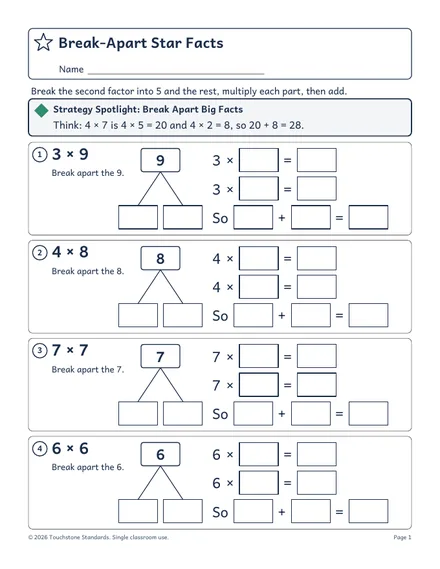 See the format first, free. Break-Apart Star Facts is four Grade 3 pages with an answer key.