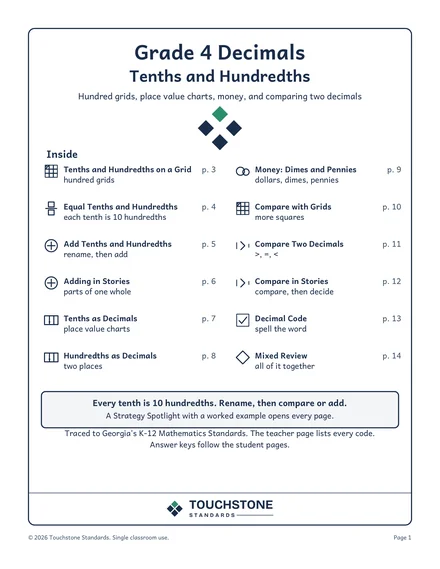
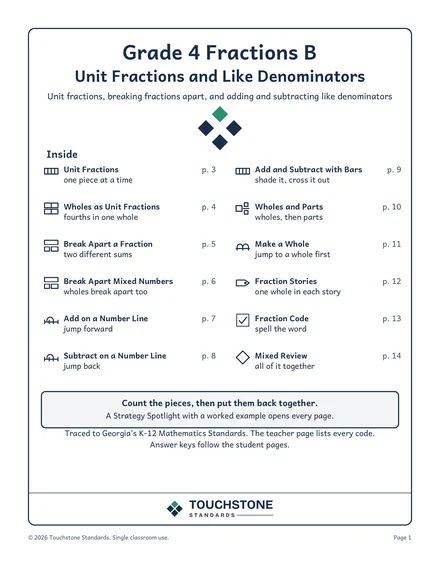
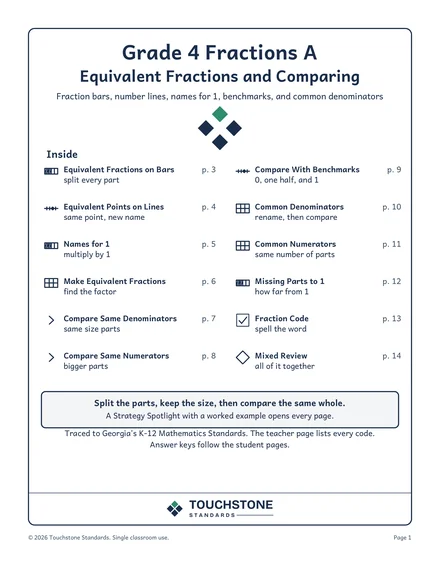
What students practice
Fifteen review sets touch all 30 Grade 4 elements, with four original items per set and a worked Strategy Spotlight on every review-set page. Two half-length practice tests have 25 items and 29 points each. Together they match the July 2025 blueprint's 58-point group allocations, with DOK Levels 1, 2 and 3 inside the published bands. Full worked keys show calculations, diagrams, estimates and scoring.
Inspect actual pages and matching keys
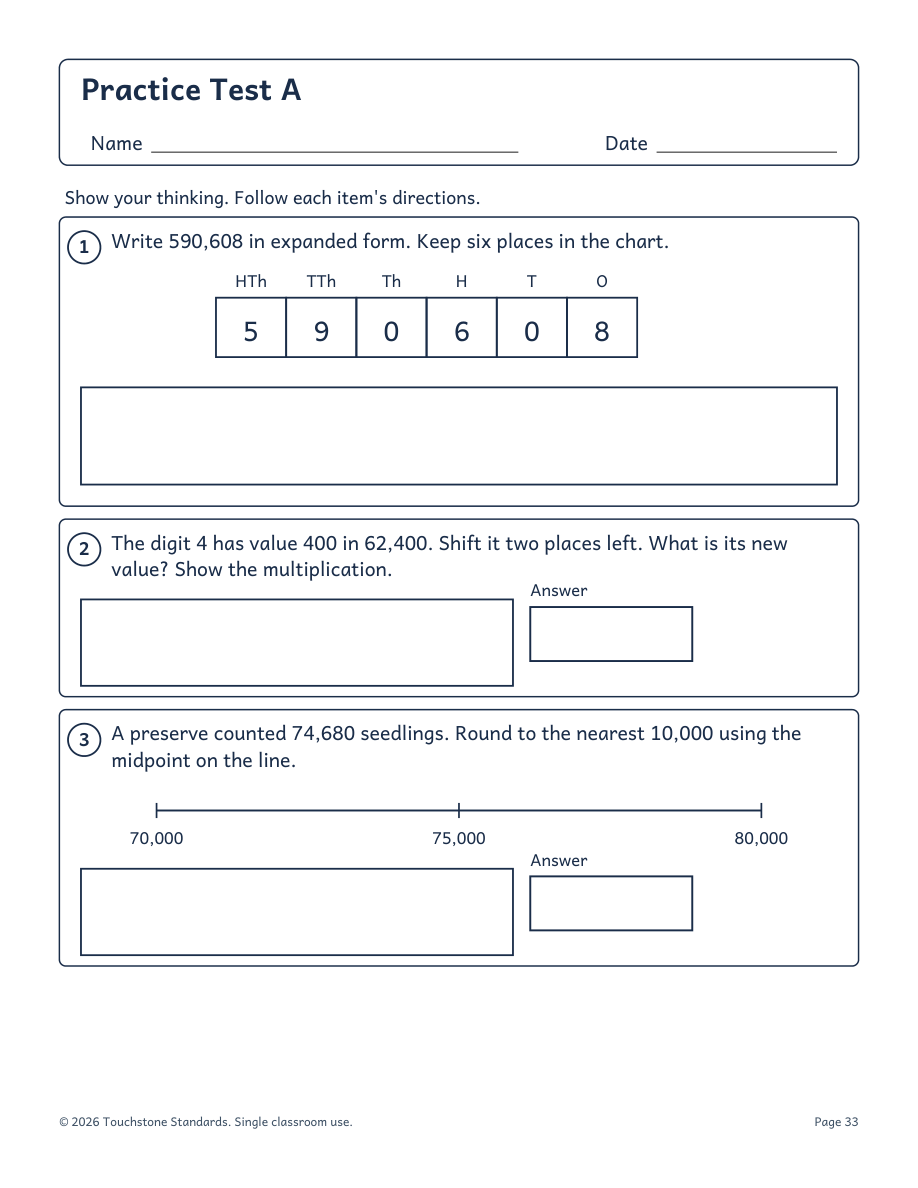
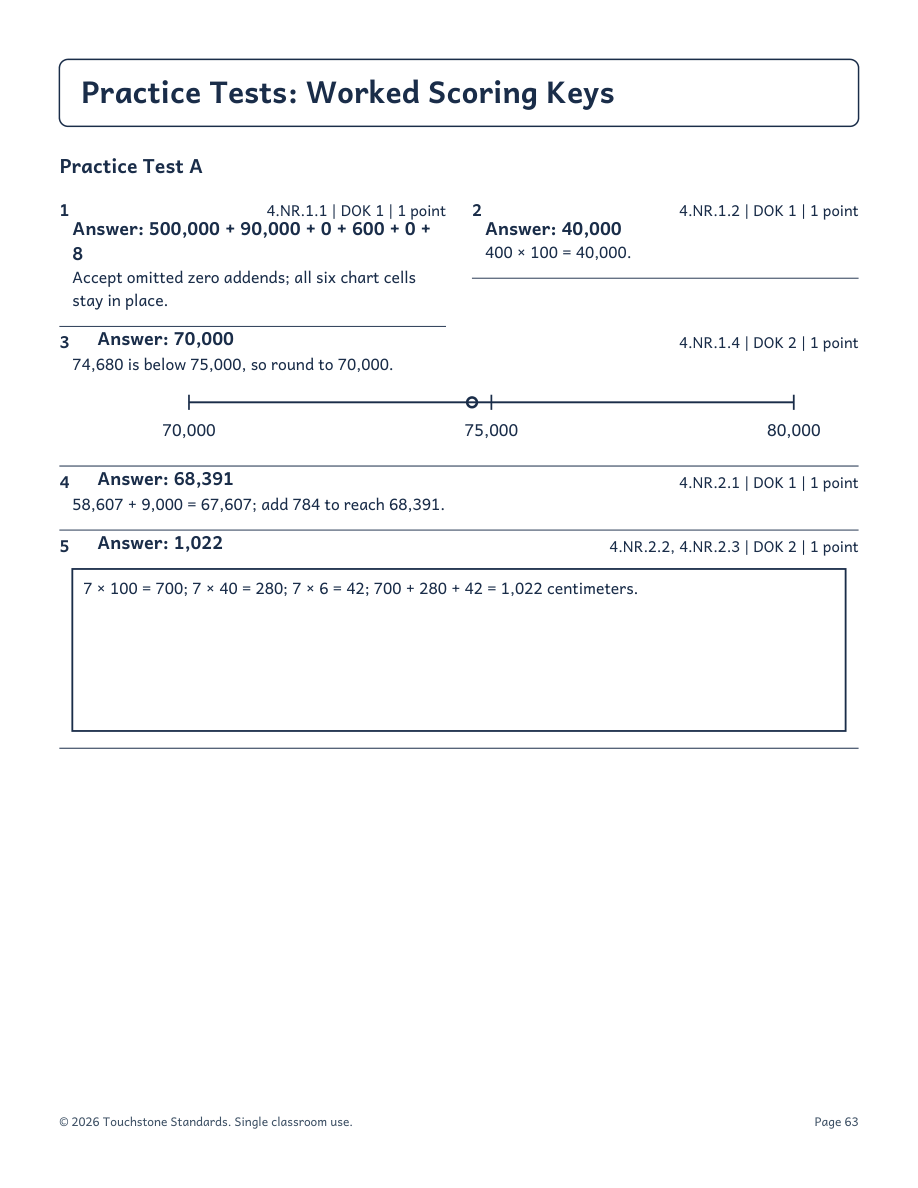
These complete pages come from this packet. Check the task, work space, and key before choosing.
Download the free 6-page PDF preview (cover, teacher page, and two complete practice/key pairs).
Patterns and Observations
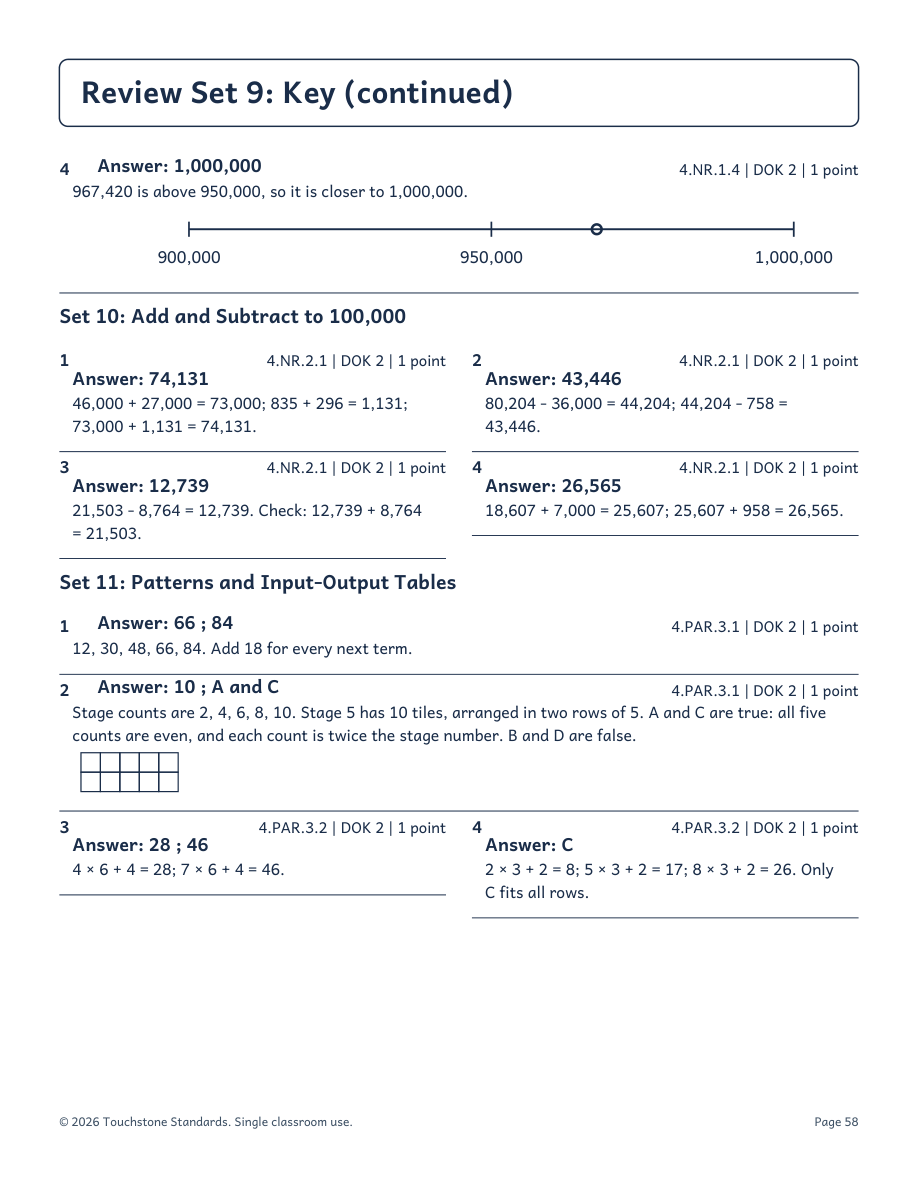
Practice Test A
What's inside
- p. 7
Set 1: Equivalent Fractions and Comparing
- p. 8
Set 2: Decompose, Add, and Subtract Fractions
- p. 9
Set 3: Measure and Make Line Plots
- p. 10
Set 3: Measure and Make Line Plots
- p. 11
Set 4: Tenths, Hundredths, and Decimals
- p. 12
Set 4: Tenths, Hundredths, and Decimals
- p. 13
Set 5: Elapsed Time and Metric Measurement
- p. 14
Set 5: Elapsed Time and Metric Measurement
- p. 15
Set 6: Angles: Wedges, Drawing, and Measuring
- p. 16
Set 6: Angles: Wedges, Drawing, and Measuring
- p. 17
Set 7: Lines, Symmetry, and Classifying Polygons
- p. 18
Set 8: Area and Perimeter of Composite Rectangles
- p. 19
Set 8: Area and Perimeter of Composite Rectangles
- p. 20
Set 9: Place Value and Rounding
- p. 21
Set 9: Place Value and Rounding
- p. 22
Set 10: Add and Subtract to 100,000
- p. 23
Set 10: Add and Subtract to 100,000
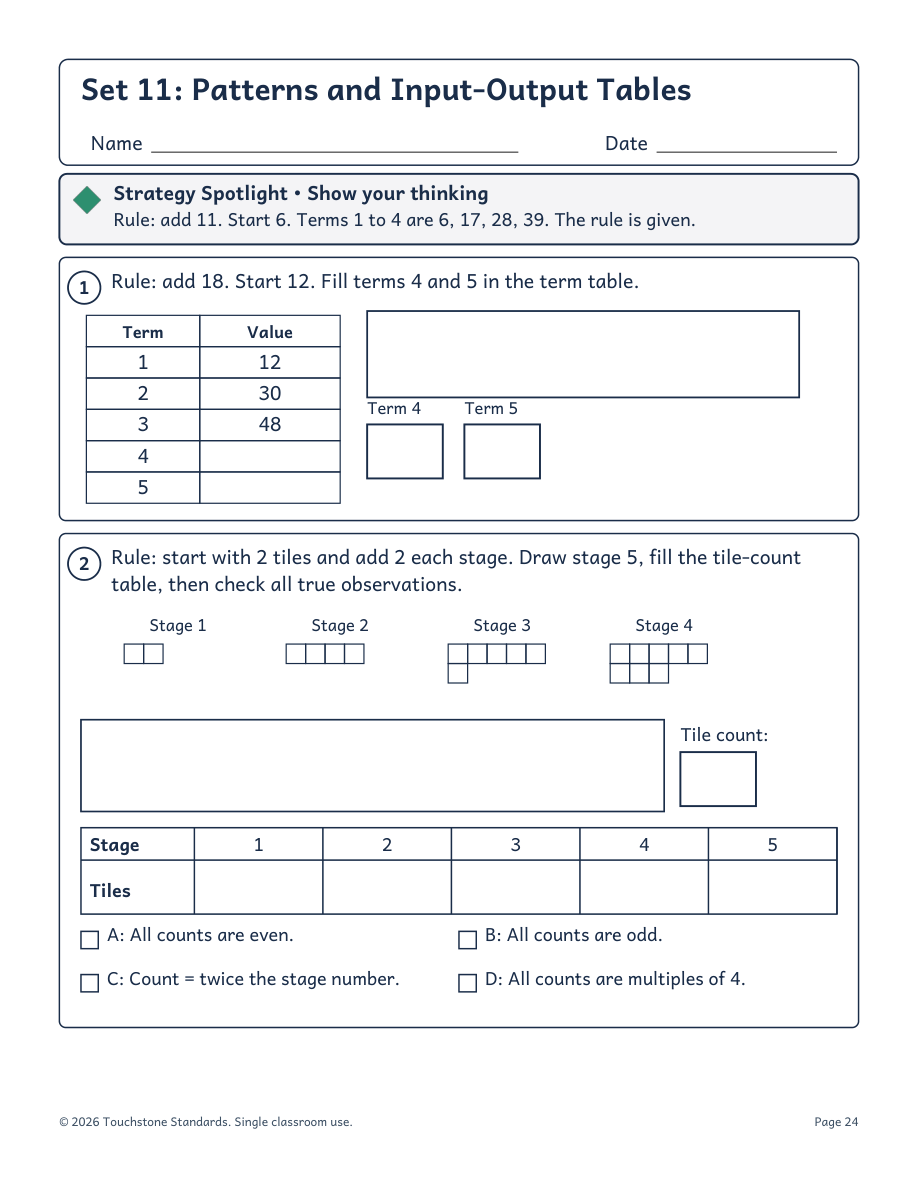
- p. 24
Set 11: Patterns and Input-Output Tables
- p. 25
Set 11: Patterns and Input-Output Tables
- p. 26
Set 12: Factors, Multiples, Prime, and Composite
- p. 27
Set 13: Comparison and Multiplication
- p. 28
Set 13: Comparison and Multiplication
- p. 29
Set 14: Division and Remainder Decisions
- p. 30
Set 14: Division and Remainder Decisions
- p. 31
Set 15: Multi-Step Problems and Reasonableness
- p. 32
Set 15: Multi-Step Problems and Reasonableness
- p. 33
Practice Test A
- p. 34
Practice Test A
- p. 35
Practice Test A
- p. 36
Practice Test A
- p. 37
Practice Test A
- p. 38
Practice Test A
- p. 39
Practice Test A
- p. 40
Practice Test A
- p. 41
Practice Test A
- p. 42
Practice Test A
- p. 43
Practice Test B
- p. 44
Practice Test B
- p. 45
Practice Test B
- p. 46
Practice Test B
- p. 47
Practice Test B
- p. 48
Practice Test B
- p. 49
Practice Test B
- p. 50
Practice Test B
- p. 51
Practice Test B
Georgia standards covered
4.NR.1.1
Read and write multi-digit whole numbers to the hundred-thousands place using base-ten numerals and expanded form.
In this packet: pages 20, 33, and 43. 4.NR.1.1 practice in all our packets
4.NR.1.2
Recognize and show that a digit in one place has a value ten times greater than what it represents in the place to its right and extend this understanding to determine the value of a digit when it is shifted to the left or right, based on the relationship between multiplication and division.
In this packet: pages 20, 33, and 43. 4.NR.1.2 practice in all our packets
4.NR.1.3
Use place value reasoning to represent, compare, and order multi-digit numbers, using >, =, and < symbols to record the results of comparisons.
In this packet: pages 20 and 43. 4.NR.1.3 practice in all our packets
4.NR.1.4
Use place value understanding to round multi-digit whole numbers.
In this packet: pages 21, 33, and 44. 4.NR.1.4 practice in all our packets
4.NR.2.1
Fluently add and subtract multi-digit numbers to solve practical, mathematical problems using place value understanding, properties of operations, and relationships between operations.
In this packet: pages 22, 23, 34, and 44. 4.NR.2.1 practice in all our packets
4.NR.2.2
Interpret, model, and solve problems involving multiplicative comparison.
In this packet: pages 27 and 34. 4.NR.2.2 practice in all our packets
4.NR.2.3
Solve relevant problems involving multiplication of a number with up to four digits by a 1-digit whole number or involving multiplication of two two-digit numbers using strategies based on place value and the properties of operations. Illustrate and explain the calculation by using equations, rectangular arrays, and/or area models.
In this packet: pages 28 and 34. 4.NR.2.3 practice in all our packets
4.NR.2.4
Solve authentic division problems involving up to 4-digit dividends and 1-digit divisors (including whole number quotients with remainders) using strategies based on place-value understanding, properties of operations, and the relationships between operations.
In this packet: pages 29, 30, and 44. 4.NR.2.4 practice in all our packets
4.NR.2.5
Solve multi-step problems using addition, subtraction, multiplication, and division involving whole numbers. Use mental computation and estimation strategies to justify the reasonableness of solutions.
In this packet: pages 31, 32, 35, and 45. 4.NR.2.5 practice in all our packets
4.PAR.3.1
Generate both number and shape patterns that follow a provided rule.
In this packet: pages 24, 35, and 45. 4.PAR.3.1 practice in all our packets
4.PAR.3.2
Use input-output rules, tables, and charts to represent and describe patterns, find relationships, and solve problems.
In this packet: pages 25, 36, and 45. 4.PAR.3.2 practice in all our packets
4.PAR.3.3
Find factor pairs in the range 1-100 and find multiples of single-digit numbers up to 100.
In this packet: pages 26 and 36. 4.PAR.3.3 practice in all our packets
4.PAR.3.4
Identify composite numbers and prime numbers and explain the relationship with the factor pairs.
In this packet: pages 26 and 46. 4.PAR.3.4 practice in all our packets
4.NR.4.1
Using concrete materials, drawings, and number lines, demonstrate and explain the relationship between equivalent fractions, including fractions greater than one, and explain the identity property of multiplication as it relates to equivalent fractions. Generate equivalent fractions using these relationships.
In this packet: pages 7, 36, and 46. 4.NR.4.1 practice in all our packets
4.NR.4.2
Compare two fractions with the same numerator or the same denominator by reasoning about their size and recognize that comparisons are valid only when the two fractions refer to the same whole.
In this packet: pages 7 and 46. 4.NR.4.2 practice in all our packets
4.NR.4.3
Compare two fractions with different numerators and/or different denominators by flexibly using a variety of tools and strategies and recognize that comparisons are valid only when the two fractions refer to the same whole.
In this packet: pages 7 and 46. 4.NR.4.3 practice in all our packets
4.NR.4.4
Represent whole numbers and fractions as the sum of unit fractions.
In this packet: pages 8 and 37. 4.NR.4.4 practice in all our packets
4.NR.4.5
Represent a fraction as a sum of fractions with the same denominator in more than one way, recording with an equation.
In this packet: pages 8 and 36. 4.NR.4.5 practice in all our packets
4.NR.4.6
Add and subtract fractions and mixed numbers with like denominators using a variety of tools.
In this packet: pages 8, 37, and 46. 4.NR.4.6 practice in all our packets
4.NR.5.1
Demonstrate and explain the concept of equivalent fractions with denominators of 10 and 100, using concrete materials and visual models. Add two fractions with denominators of 10 and 100.
In this packet: pages 11, 37, and 47. 4.NR.5.1 practice in all our packets
4.NR.5.2
Represent, read, and write fractions with denominators of 10 or 100 using decimal notation, and decimal numbers to the hundredths place as fractions, using concrete materials and drawings.
In this packet: pages 11, 12, 38, and 47. 4.NR.5.2 practice in all our packets
4.NR.5.3
Compare two decimal numbers to the hundredths place by reasoning about their size. Record the results of comparisons with the symbols >, =, or <, and justify the conclusions.
In this packet: pages 12, 38, and 47. 4.NR.5.3 practice in all our packets
4.MDR.6.1
Use the four operations to solve problems involving elapsed time to the nearest minute, intervals of time, metric measurements of liquid volumes, lengths, distances, and masses of objects, including problems involving fractions with like denominators, and also problems that require expressing measurements given in a larger unit in terms of a smaller unit, and expressing a smaller unit in terms of a larger unit based on the idea of equivalence.
In this packet: pages 13, 14, 38, and 48. 4.MDR.6.1 practice in all our packets
4.MDR.6.2
Ask questions and answer them based on gathered information, observations, and appropriate graphical displays to solve problems relevant to everyday life.
In this packet: pages 10, 39, and 49. 4.MDR.6.2 practice in all our packets
4.MDR.6.3
Create dot plots to display a distribution of numerical (quantitative) measurement data.
In this packet: pages 9, 10, 38, and 49. 4.MDR.6.3 practice in all our packets
4.GSR.7.1
Recognize angles as geometric shapes formed when two rays share a common endpoint. Draw right, acute, and obtuse angles based on the relationship of the angle measure to 90 degrees.
In this packet: pages 15 and 41. 4.GSR.7.1 practice in all our packets
4.GSR.7.2
Measure angles in reference to a circle with the center at the common endpoint of two rays. Determine an angle’s measure in relation to the 360 degrees in a circle through division or as a missing factor problem.
In this packet: pages 15, 16, 39, 40, 49, and 50. 4.GSR.7.2 practice in all our packets
4.GSR.8.1
Explore, investigate, and draw points, lines, line segments, rays, angles (right, acute, obtuse), perpendicular lines, parallel lines, and lines of symmetry. Identify these in two-dimensional figures.
In this packet: pages 17, 41, and 51. 4.GSR.8.1 practice in all our packets
4.GSR.8.2
Classify, compare, and contrast polygons based on lines of symmetry, the presence or absence of parallel or perpendicular line segments, or the presence or absence of angles of a specified size and based on side lengths.
In this packet: pages 17, 41, and 51. 4.GSR.8.2 practice in all our packets
4.GSR.8.3
Solve problems involving area and perimeter of composite rectangles involving whole numbers with known side lengths.
In this packet: pages 18, 19, 42, and 51. 4.GSR.8.3 practice in all our packets
Who it's for
Grade 4 teachers preparing for the spring End-of-Grade assessment or revisiting one skill at a time. The teacher map connects the first eight sets to live unit packets and marks the seven fall units as future packets. Students answer on the test pages; an optional circle-choice sheet, progress tracker and teacher item analysis help plan follow-up practice. Use a classroom protractor for drawing tasks and print at Actual Size / 100%. This is original paper practice, not an official test or an online-interface simulation.