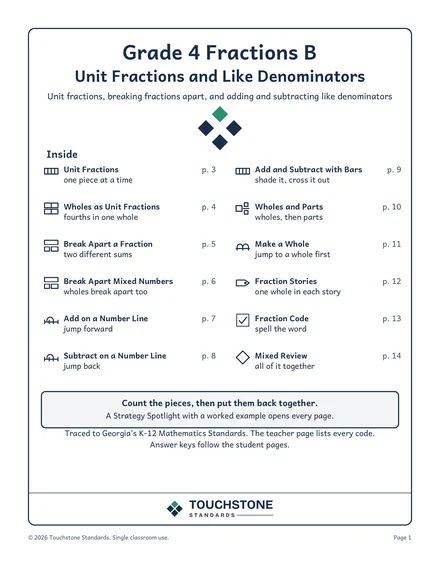
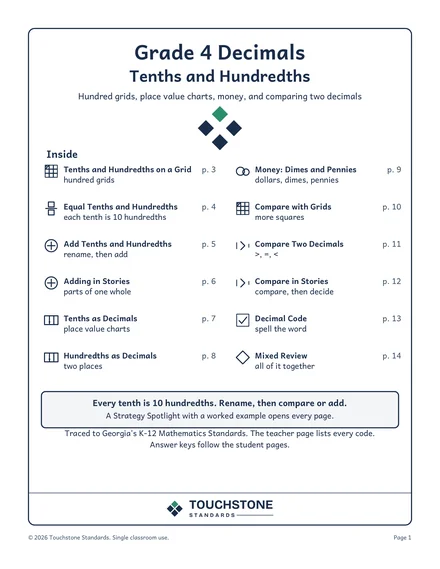
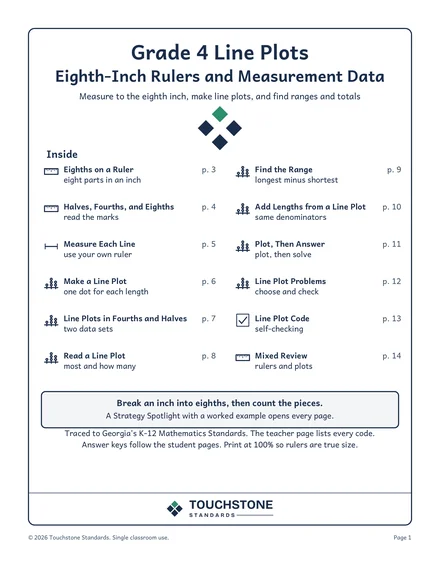
What students practice
Students split every part of a fraction bar into the same number of smaller parts to find an equivalent fraction, mark the same point on two number lines, including lines that run past 1, and see that multiplying the top and the bottom by the same number is multiplying by 1, which does not change the value. Then they compare two fractions with the same denominator or numerator, with the benchmarks 0, one half, and 1, by renaming to a common denominator or numerator, and by the missing part to 1. A self-checking code page and a Mixed Review finish the packet.
What's inside
- p. 3
Equivalent Fractions on Bars
Shade the second bar to match the first, then write the missing number.
- p. 4
Equivalent Points on Lines
Mark the same point on the second line, then write the missing number.
- p. 5
Names for 1
Multiply the top and bottom by the same number, then write the new fraction.
- p. 6
Make Equivalent Fractions
Write the missing number to make the fractions equal.
- p. 7
Compare Same Denominators
Write >, =, or < to compare the fractions.
- p. 8
Compare Same Numerators
Write >, =, or < to compare the fractions.
- p. 9
Compare With Benchmarks
Compare each fraction to the benchmark, then compare the two fractions.
- p. 10
Common Denominators
Rename both fractions with the same denominator, then compare.
- p. 11
Common Numerators
Rename both fractions with the same numerator, then compare.
- p. 12
Missing Parts to 1
Write how much each fraction needs to make 1, then compare.
- p. 13
Fraction Code
Solve each problem, then use the code to spell the word.
- p. 14
Mixed Review
Use any strategy from this packet.
Georgia standards covered
4.NR.4.1
Using concrete materials, drawings, and number lines, demonstrate and explain the relationship between equivalent fractions, including fractions greater than one, and explain the identity property of multiplication as it relates to equivalent fractions. Generate equivalent fractions using these relationships.
In this packet: pages 3 to 6, 13, and 14. 4.NR.4.1 practice in all our packets
4.NR.4.2
Compare two fractions with the same numerator or the same denominator by reasoning about their size and recognize that comparisons are valid only when the two fractions refer to the same whole.
In this packet: pages 7, 8, and 14. 4.NR.4.2 practice in all our packets
4.NR.4.3
Compare two fractions with different numerators and/or different denominators by flexibly using a variety of tools and strategies and recognize that comparisons are valid only when the two fractions refer to the same whole.
In this packet: pages 9 to 12 and 14. 4.NR.4.3 practice in all our packets
Who it's for
Grade 4 classes starting the fractions unit. Denominators are 2, 3, 4, 5, 6, 8, 10, 12, and 100, fractions greater than 1 are written as fractions, and nothing is added or subtracted (that is Fractions B). Every comparison is between two fractions, and every comparison page asks whether they refer to the same whole. Student pages never name a property.
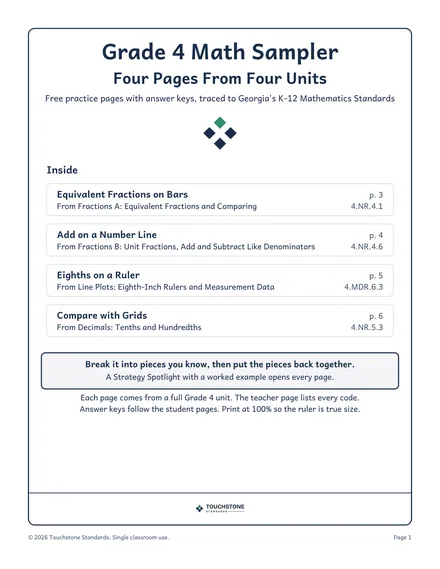 See the format first, free. The free Grade 4 Math Sampler has one practice page from four units, each with its answer key.