What students practice
Sixteen review sets cover all 38 Grade 6 elements. Each set opens with a worked example. Then two 25-item practice tests, 29 points each, give every standard group the same share of points it has on the Grade 6 Milestones blueprint. Together the two tests carry the full 58 blueprint points. DOK levels 1, 2, and 3 stay inside the blueprint ranges. Items are paper versions of the Milestones formats: multiple choice, keypad entry, drop-down, select all, plot, and two-part items.
What's inside
- p. 8
Add and Subtract Fractions
- p. 9
Add and Subtract Fractions (continued)
- p. 10
Multiply and Divide Fractions
- p. 11
Decimal Operations
- p. 12
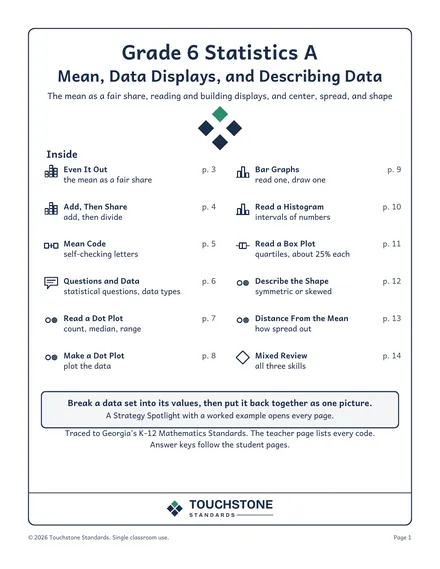
Mean and Data Displays
- p. 13
Mean and Data Displays (continued)
- p. 14
Describe and Compare Data
- p. 15
Describe and Compare Data (continued)
- p. 16
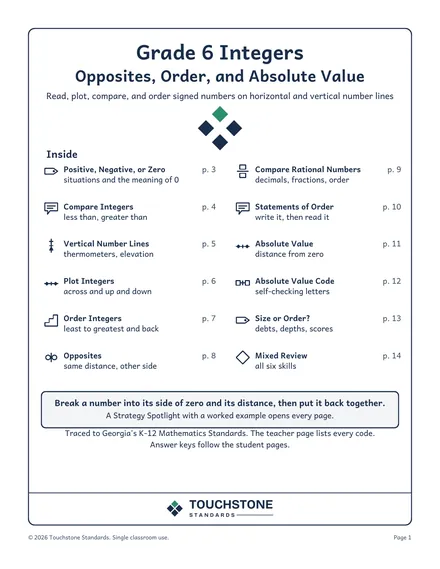
Integers and Opposites
- p. 17
Integers and Opposites (continued)
- p. 18
Order and Absolute Value
- p. 19
Order and Absolute Value (continued)
- p. 20
Ratios and Tables
- p. 21
Ratios and Tables (continued)
- p. 22
Rates, Percents, and Conversions
- p. 23
Rates, Percents, and Conversions (continued)
- p. 24
Area of Polygons
- p. 25
Area of Polygons (continued)
- p. 26
Surface Area and Volume
- p. 27
Surface Area and Volume (continued)
- p. 28
Exponents and Expressions
- p. 29
GCF, LCM, and Equivalent Expressions
- p. 30
One-Step Equations
- p. 31
Inequalities
- p. 32
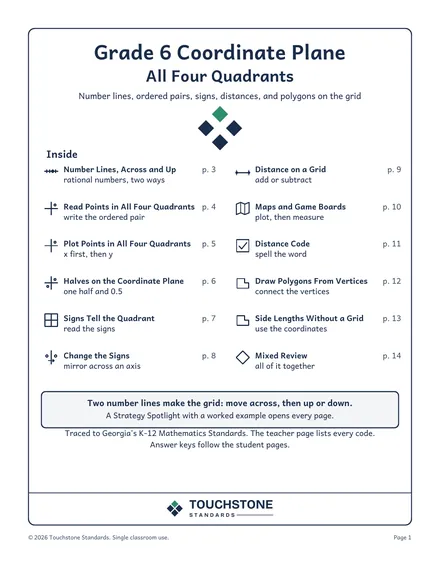
The Coordinate Plane
- p. 33
The Coordinate Plane (continued)
- p. 34
Practice Test A
- p. 35
Practice Test A
- p. 36
Practice Test A
- p. 37
Practice Test A
- p. 38
Practice Test A
- p. 39
Practice Test A
- p. 40
Practice Test A
- p. 41
Practice Test B
- p. 42
Practice Test B
- p. 43
Practice Test B
- p. 44
Practice Test B
- p. 45
Practice Test B
- p. 46
Practice Test B
- p. 49
Answer Key: Add and Subtract Fractions
- p. 50
Answer Key: Multiply and Divide Fractions
- p. 51
Answer Key: Decimal Operations
- p. 52
Answer Key: Mean and Data Displays
- p. 53
Answer Key: Mean and Data Displays (continued)
- p. 54
Answer Key: Describe and Compare Data
- p. 55
Answer Key: Describe and Compare Data (continued)
- p. 56
Answer Key: Integers and Opposites
- p. 57
Answer Key: Integers and Opposites (continued)
- p. 58
Answer Key: Order and Absolute Value
- p. 59
Answer Key: Order and Absolute Value (continued)
- p. 60
Answer Key: Ratios and Tables
- p. 61
Answer Key: Ratios and Tables (continued)
- p. 62
Answer Key: Rates, Percents, and Conversions
- p. 63
Answer Key: Rates, Percents, and Conversions (continued)
- p. 64
Answer Key: Area of Polygons
- p. 65
Answer Key: Area of Polygons (continued)
- p. 66
Answer Key: Surface Area and Volume
- p. 67
Answer Key: Surface Area and Volume (continued)
- p. 68
Answer Key: Exponents and Expressions
- p. 69
Answer Key: GCF, LCM, and Equivalent Expressions
- p. 70
Answer Key: One-Step Equations
- p. 71
Answer Key: Inequalities
- p. 72
Answer Key: The Coordinate Plane
- p. 73
Answer Key: The Coordinate Plane (continued)
- p. 74
Answer Key: Practice Test A
- p. 75
Answer Key: Practice Test A
- p. 76
Answer Key: Practice Test A
- p. 77
Answer Key: Practice Test A
- p. 78
Answer Key: Practice Test A
- p. 79
Answer Key: Practice Test A
- p. 80
Answer Key: Practice Test A
- p. 81
Answer Key: Practice Test B
- p. 82
Answer Key: Practice Test B
- p. 83
Answer Key: Practice Test B
- p. 84
Answer Key: Practice Test B
- p. 85
Answer Key: Practice Test B
- p. 86
Answer Key: Practice Test B
Georgia standards covered
6.NR.1.1
Fluently add and subtract any combination of fractions to solve problems.
In this packet: pages 8, 9, 34, 41, 49, 74, and 81. 6.NR.1.1 practice in all our packets
6.NR.1.2
Multiply and divide any combination of whole numbers, fractions, and mixed numbers using a student-selected strategy. Interpret products and quotients of fractions and solve word problems.
In this packet: pages 10, 34, 41, 50, 74, and 81. 6.NR.1.2 practice in all our packets
6.NR.1.3
Perform operations with multi-digit decimal numbers fluently using models and student-selected strategies.
In this packet: pages 11, 34, 41, 51, 74, and 81. 6.NR.1.3 practice in all our packets
6.NR.2.1
Describe and interpret the center of the distribution by the equal share value (mean).
In this packet: pages 12, 13, 34, 41, 52, 53, 74, and 81. 6.NR.2.1 practice in all our packets
6.NR.2.2
Summarize categorical and quantitative (numerical) data sets in relation to the context: display the distributions of quantitative (numerical) data in plots on a number line, including dot plots, histograms, and box plots and display the distribution of categorical data using bar graphs.
In this packet: pages 12, 13, 42, 52, 53, and 82. 6.NR.2.2 practice in all our packets
6.NR.2.3
Interpret numerical data to answer a statistical investigative question created. Describe the distribution of a quantitative (numerical) variable collected, including its center, variability, and overall shape.
In this packet: pages 14, 34, 54, and 74. 6.NR.2.3 practice in all our packets
6.NR.2.4
Design simple experiments and collect data. Use data gathered from realistic scenarios and simulations to determine quantitative measures of center (median and/or mean) and variability (interquartile range and range). Use these quantities to draw conclusions about the data, compare different numerical data sets, and make predictions.
In this packet: pages 14, 15, 35, 54, 55, and 75. 6.NR.2.4 practice in all our packets
6.NR.2.5
Relate the choice of measures of center and variability to the shape of the data distribution and the context in which the data were gathered.
In this packet: pages 15 and 55. 6.NR.2.5 practice in all our packets
6.NR.2.6
Describe the impact that inserting or deleting a data point has on the mean and the median of a data set. Create data displays using a dot plot or box plot to examine this impact.
In this packet: pages 15, 42, 55, and 82. 6.NR.2.6 practice in all our packets
6.NR.3.1
Identify and compare integers and explain the meaning of zero based on multiple authentic situations.
In this packet: pages 16, 41, 56, and 81. 6.NR.3.1 practice in all our packets
6.NR.3.2
Order and plot integers on a number line and use distance from zero to discover the connection between integers and their opposites.
In this packet: pages 16, 35, 56, and 75. 6.NR.3.2 practice in all our packets
6.NR.3.3
Recognize and explain that opposite signs of integers indicate locations on opposite sides of zero on the number line; recognize and explain that the opposite of the opposite of a number is the number itself.
In this packet: pages 17, 42, 57, and 82. 6.NR.3.3 practice in all our packets
6.NR.3.4
Write, interpret, and explain statements of order for rational numbers in authentic, mathematical situations. Compare rational numbers, including integers, using equality and inequality symbols.
In this packet: pages 18, 35, 58, and 75. 6.NR.3.4 practice in all our packets
6.NR.3.5
Explain the absolute value of a rational number as its distance from zero on the number line; interpret absolute value as distance for a positive or negative quantity in a relevant situation.
In this packet: pages 18, 35, 43, 58, 75, and 83. 6.NR.3.5 practice in all our packets
6.NR.3.6
Distinguish comparisons of absolute value from statements about order.
In this packet: pages 18, 19, 36, 58, 59, and 76. 6.NR.3.6 practice in all our packets
6.NR.4.1
Explain the concept of a ratio, represent ratios, and use ratio language to describe a relationship between two quantities.
In this packet: pages 20, 36, 43, 60, 76, and 83. 6.NR.4.1 practice in all our packets
6.NR.4.2
Make tables of equivalent ratios relating quantities with whole-number measurements, find missing values in the tables, and plot the pairs of values on the coordinate plane. Use tables to compare ratios.
In this packet: pages 20, 21, 36, 60, 61, and 76. 6.NR.4.2 practice in all our packets
6.NR.4.3
Solve problems involving proportions using a variety of student-selected strategies.
In this packet: pages 21 and 61. 6.NR.4.3 practice in all our packets
6.NR.4.4
Describe the concept of rates and unit rate in the context of a ratio relationship.
In this packet: pages 22 and 62. 6.NR.4.4 practice in all our packets
6.NR.4.5
Solve unit rate problems including those involving unit pricing and constant speed.
In this packet: pages 22, 43, 62, and 83. 6.NR.4.5 practice in all our packets
6.NR.4.6
Calculate a percent of a quantity as a rate per 100 and solve everyday problems given a percent.
In this packet: pages 22, 35, 62, and 75. 6.NR.4.6 practice in all our packets
6.NR.4.7
Use ratios to convert within measurement systems (customary and metric) to solve authentic problems that exist in everyday life.
In this packet: pages 23, 43, 62, 63, and 83. 6.NR.4.7 practice in all our packets
6.GSR.5.1
Explore area as a measurable attribute of triangles, quadrilaterals, and other polygons conceptually by composing or decomposing into rectangles, triangles, and other shapes. Find the area of these geometric figures to solve problems.
In this packet: pages 24, 25, 37, 43, 64, 65, 77, and 83. 6.GSR.5.1 practice in all our packets
6.GSR.5.2
Given the net of three-dimensional figures with rectangular and triangular faces, determine the surface area of these figures.
In this packet: pages 26, 27, 37, 44, 66, 67, 77, and 84. 6.GSR.5.2 practice in all our packets
6.GSR.5.3
Calculate the volume of right rectangular prisms with fractional edge lengths by applying the formula, V = (area of base) x (height).
In this packet: pages 27, 37, 44, 67, 77, and 84. 6.GSR.5.3 practice in all our packets
6.PAR.6.1
Write and evaluate numerical expressions involving rational bases and whole-number exponents.
In this packet: pages 28, 38, 44, 68, 78, and 84. 6.PAR.6.1 practice in all our packets
6.PAR.6.2
Determine greatest common factors and least common multiples using a variety of strategies to make sense of applicable problems.
In this packet: pages 29, 38, 69, and 78. 6.PAR.6.2 practice in all our packets
6.PAR.6.3
Write and read expressions that represent operations with numbers and variables in realistic situations.
In this packet: pages 28, 44, 68, and 84. 6.PAR.6.3 practice in all our packets
6.PAR.6.4
Evaluate expressions when given values for the variables, including expressions that arise in everyday situations.
In this packet: pages 28, 45, 68, and 85. 6.PAR.6.4 practice in all our packets
6.PAR.6.5
Apply the properties of operations to identify and generate equivalent expressions.
In this packet: pages 29, 38, 69, and 78. 6.PAR.6.5 practice in all our packets
6.PAR.7.1
Solve one-step equations and inequalities involving variables when values for the variables are given. Determine whether an equation and inequality involving a variable is true or false for a given value of the variable.
In this packet: pages 30, 31, 38, 45, 70, 71, 78, and 85. 6.PAR.7.1 practice in all our packets
6.PAR.7.2
Write one-step equations and inequalities to represent and solve problems; explain that a variable can represent an unknown number or any number in a specified set.
In this packet: pages 30, 31, 45, 70, 71, and 85. 6.PAR.7.2 practice in all our packets
6.PAR.7.3
Solve problems by writing and solving equations of the form x ± p = q, px = q and x/p = q for cases in which p, q and x are all nonnegative rational numbers.
In this packet: pages 30, 39, 45, 70, 79, and 85. 6.PAR.7.3 practice in all our packets
6.PAR.7.4
Recognize and generate inequalities of the form x > c, x ≥ c, x < c, or x ≤ c to explain situations that have infinitely many solutions; represent solutions of such inequalities on a number line.
In this packet: pages 31, 39, 71, and 79. 6.PAR.7.4 practice in all our packets
6.PAR.8.1
Locate and position rational numbers on a horizontal or vertical number line; find and position pairs of integers and other rational numbers on a coordinate plane.
In this packet: pages 32, 39, 46, 72, 79, and 86. 6.PAR.8.1 practice in all our packets
6.PAR.8.2
Show and explain that signs of numbers in ordered pairs indicate locations in quadrants of the coordinate plane and determine how two ordered pairs may differ based only on the signs.
In this packet: pages 33, 39, 46, 73, 79, and 86. 6.PAR.8.2 practice in all our packets
6.PAR.8.3
Solve problems by graphing points in all four quadrants of the coordinate plane. Include use of coordinates and absolute value to find distances between points with the same x-coordinate or the same y-coordinate.
In this packet: pages 33, 40, 46, 73, 80, and 86. 6.PAR.8.3 practice in all our packets
6.PAR.8.4
Draw polygons in the coordinate plane given coordinates for the vertices; use coordinates to find the length of a side joining points with the same x-coordinate or the same y-coordinate.
In this packet: pages 33, 46, 73, and 86. 6.PAR.8.4 practice in all our packets
Who it's for
Grade 6 teachers preparing for the spring End-of-Grade test. A code map tags every item with the code, DOK level, and format. Students mark multiple-choice answers on a bubble sheet and track progress by skill. An item analysis grid points to the review set to reteach from between Test A and Test B. Histograms and box plots are read, not built. There are no operations on negative numbers, and percents stay at or under 100%.
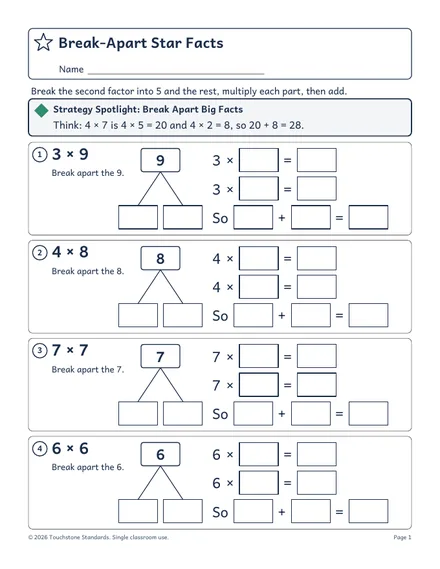 See the format first, free. Our free Grade 3 sample, Break-Apart Star Facts, shows the same page layout and answer key style.