What students practice
Area starts with covering. Students count unit squares, choose the one covering with no gaps or overlaps, and draw the tiles themselves from tick marks. Rows and columns turn into repeated addition and then multiplication, and later pages multiply length by width, find a missing side, break a rectangle into two parts, and add the parts of shapes made of two rectangles. Every side length is 10 or less.
What's inside
- p. 3
Cover and Count
Count the same-size squares that cover each rectangle, then write the area.
- p. 4
No Gaps, No Overlaps
Circle the rectangle that is covered the right way, then write its area.
- p. 5
Draw the Tiles
Join the marks to draw the unit squares, then count to find the area.
- p. 6
Shapes Made of Rectangles
Count the squares in each part, then add to find the area of the whole shape.
- p. 7
Rows and Columns
Count the rows, add the rows, then multiply to find the area.
- p. 8
Length × Width
Multiply the length by the width to find the area of each rectangle.
- p. 9
Find the Missing Side
Use the area and the side you know to find the missing side.
- p. 10
Break Apart a Rectangle
Find the area of each part, then add the parts to find the whole area.
- p. 11
Split and Add
Find the area of each part, then add to find the area of the whole shape.
- p. 12
Tile Stories
Read each story, draw the tiles if it helps, then write the area.
- p. 13
Area Stories
Read each story, draw a rectangle if it helps, then solve.
- p. 14
Mixed Review
Read each section, then find each area or missing side.
Think: 3 rows of 3 squares cover it, so the area is 9 square units.
Georgia standards covered
3.GSR.7.1
Investigate area by covering the space of rectangles presented in realistic situations using multiple copies of the same unit, with no gaps or overlaps, and determine the total area (total number of units that covered the space).
In this packet: pages 3, 4, and 14. 3.GSR.7.1 practice in all our packets
3.GSR.7.2
Determine the area of rectangles (or shapes composed of rectangles) presented in relevant problems by tiling and counting.
In this packet: pages 5, 6, 12, and 14. 3.GSR.7.2 practice in all our packets
3.GSR.7.3
Discover and explain how area can be found by multiplying the dimensions of a rectangle.
In this packet: pages 7 to 11, 13, and 14. 3.GSR.7.3 practice in all our packets
Who it's for
Grade 3 classes on the area half of the length, perimeter, and area unit. Units are square units or customary square units (inches, feet, yards), and the teacher page points to our Perimeter packet for the other half.
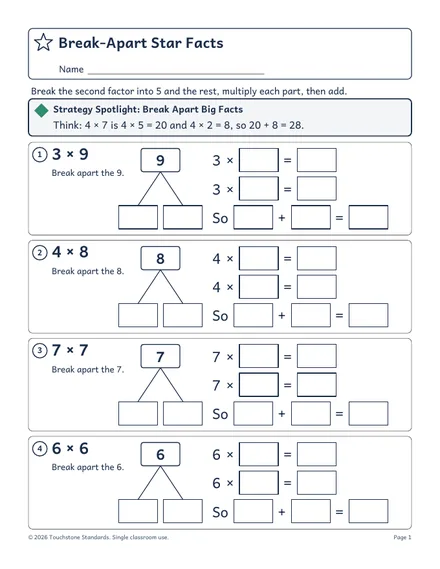 See the format first, free. Break-Apart Star Facts is four Grade 3 pages with an answer key.