What students practice
Students list factors and multiples, finish prime factor trees, and find the GCF of two numbers up to 100 and the LCM of two numbers up to 12. Word problems ask whether things are shared equally or repeat until they meet before any arithmetic. The second half combines like terms, multiplies each term inside parentheses, reads area models, factors out the GCF, and tests expressions with numbers to decide whether they are equivalent.
What's inside
- p. 3
Factors and the GCF
List the factors of each number, then write the greatest common factor.
- p. 4
Prime Factor Trees
Finish each factor tree, then use prime factors to find each GCF.
- p. 5
Multiples and the LCM
List multiples of each number, then write the least common multiple.
- p. 6
GCF and LCM Code
Find each GCF or LCM, then use the code to find the hidden word.
- p. 7
GCF and LCM Word Problems
Decide whether each problem needs a GCF or an LCM, then solve it.
- p. 8
Factor a Sum With the GCF
Write each sum as the GCF times a sum, then answer the last question.
- p. 9
Combine Like Terms
Combine like terms to write an equivalent expression.
- p. 10
Multiply Each Term
Multiply each term inside the parentheses to write an equivalent expression.
- p. 11
Area Models
Use each area model to write the area as a product and as a sum.
- p. 12
Factor Out the GCF
Use the GCF to write each expression as a product, then answer the last question.
- p. 13
Equivalent or Not
Find the value of each expression for both values, then decide.
- p. 14
Mixed Review
Solve each problem, then check your work.
Think: 12 and 20 share the factors 1, 2, and 4, so the GCF of 12 and 20 is 4.
Georgia standards covered
6.PAR.6.2
Determine greatest common factors and least common multiples using a variety of strategies to make sense of applicable problems.
In this packet: pages 3 to 8 and 14. 6.PAR.6.2 practice in all our packets
6.PAR.6.5
Apply the properties of operations to identify and generate equivalent expressions.
In this packet: pages 9 to 14. 6.PAR.6.5 practice in all our packets
Who it's for
Grade 6 classes on factors, multiples, and equivalent expressions, usually after our Exponents and Expressions packet. Students never have to name a property, and no coefficient is negative.
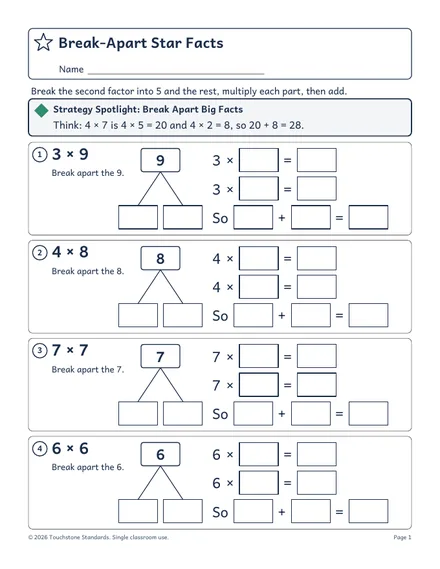 See the format first, free. Our free Grade 3 sample, Break-Apart Star Facts, shows the same page layout and answer key style.