What students practice
Connect equal sharing to fractions, then connect groups of a fraction to multiplication. Students divide whole numbers to get fractional shares, multiply a fraction or mixed number by a whole number, and explain how a factor changes the size of a product. Also aligned with Common Core: 5.NF.B.3, 5.NF.B.4a (whole-number and fraction factors), 5.NF.B.5a, 5.NF.B.5b (scaling explanations) and 5.NF.B.6 (whole-number and fraction factors).
Inspect actual pages and matching keys
These complete pages come from this packet. Check the task, work space, and key before choosing.
Download the free 6-page PDF preview (cover, teacher page, and two complete practice/key pairs).
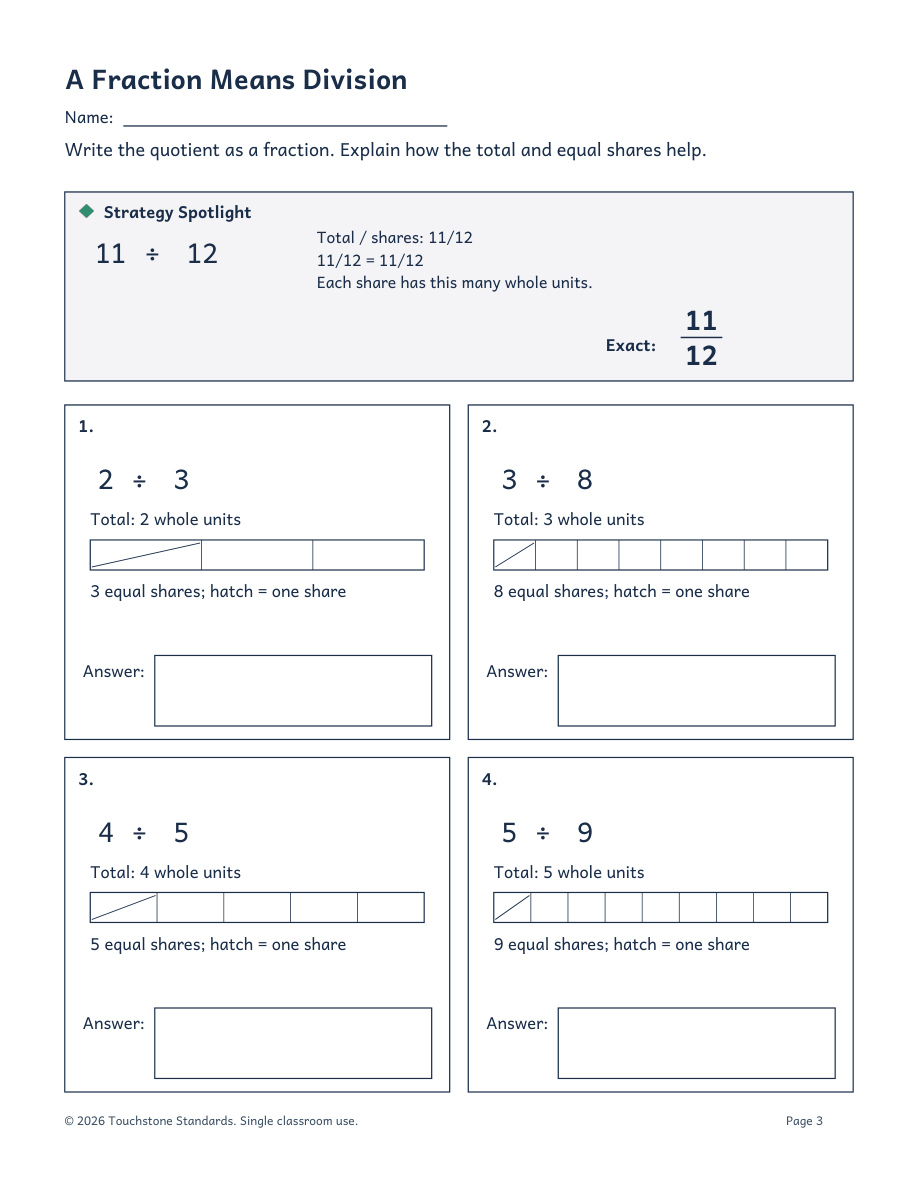
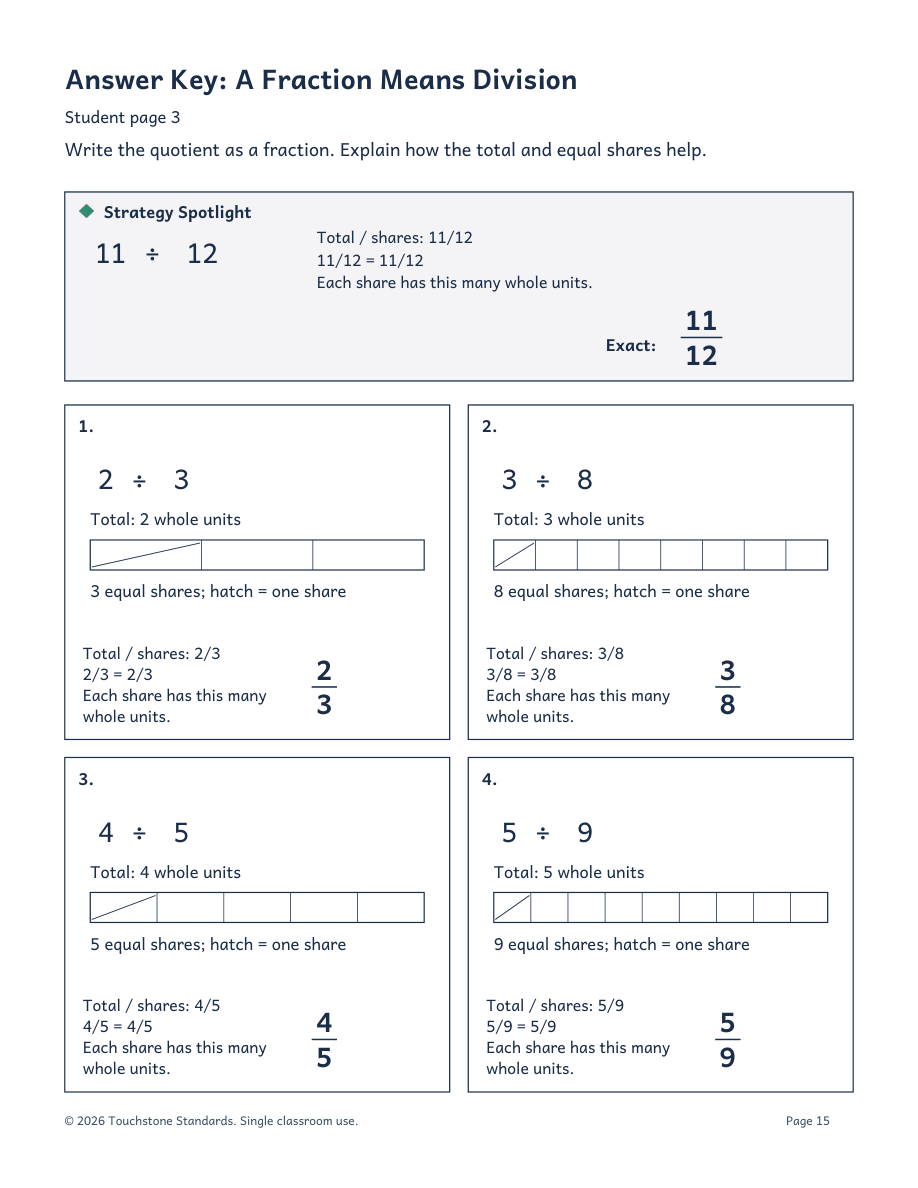
A Fraction Means Division
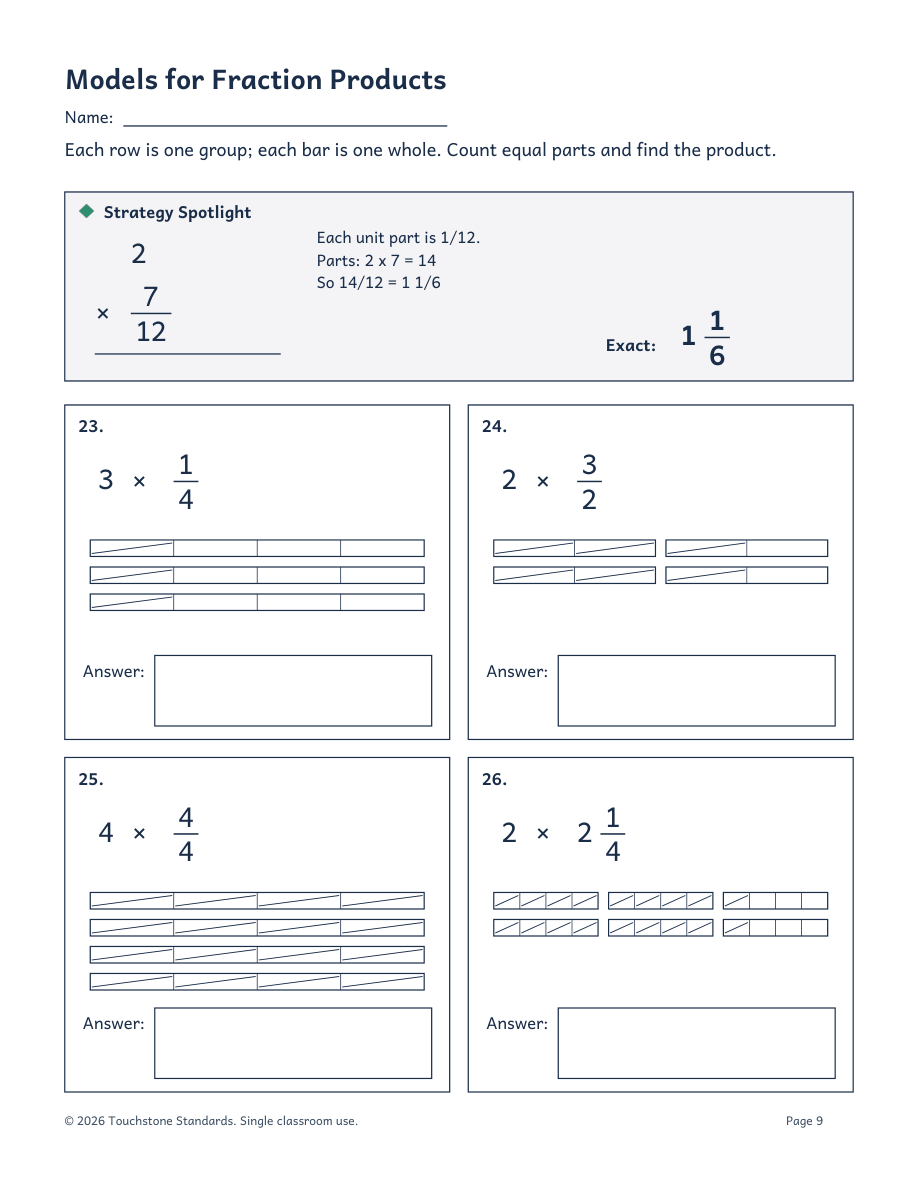
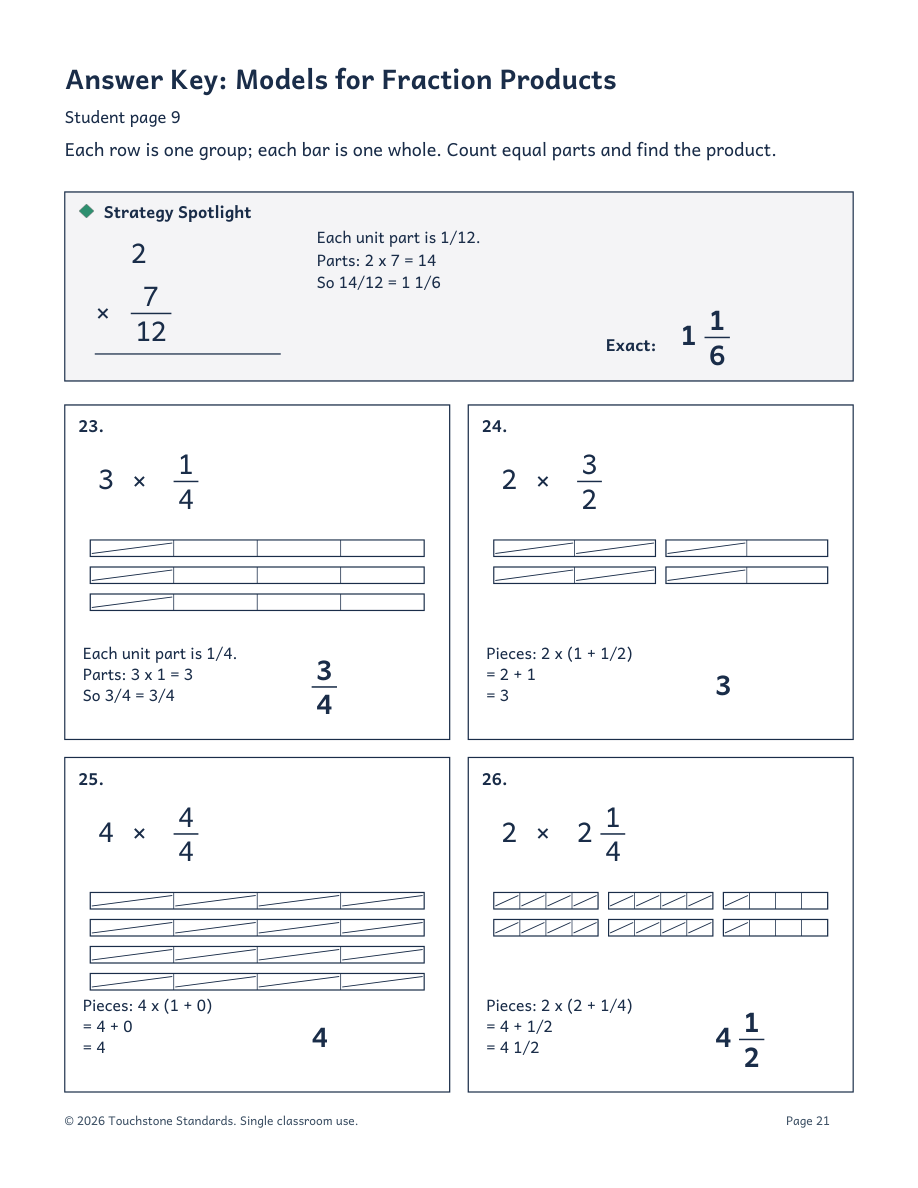
Models for Fraction Products
What's inside
- p. 3
A Fraction Means Division
- p. 4
Share More Than One Whole
- p. 5
Model Equal Shares
- p. 6
Whole-Number Division Stories
- p. 7
Multiply a Fraction by Groups
- p. 8
Multiply Beyond One
- p. 9
Models for Fraction Products
- p. 10
Predict the Product
- p. 11
Scaling in Context
- p. 12
Fraction Multiplication Stories
- p. 13
Fraction Code
- p. 14
Mixed Review
Georgia standards covered
5.NR.3.1
Explain the meaning of a fraction as division of the numerator by the denominator (a/b = a ÷ b). Solve problems involving division of whole numbers leading to answers in the form of fractions or mixed numbers.
In this packet: pages 3 to 6 and 14. 5.NR.3.1 practice in all our packets
5.NR.3.4
Model and solve problems involving multiplication of a fraction and a whole number.
In this packet: pages 7 to 9 and 12 to 14. 5.NR.3.4 practice in all our packets
5.NR.3.5
Explain why multiplying a whole number by a fraction greater than one results in a product greater than the whole number, and why multiplying a whole number by a fraction less than one results in a product less than the whole number and multiplying a whole number by a fraction equal to one results in a product equal to the whole number.
In this packet: pages 10, 11, and 14. 5.NR.3.5 practice in all our packets
Who it's for
The 44 items include 15 division tasks, 22 multiplication tasks and seven scaling explanations. Seven stories put the models to work. Students predict whether a product is greater than, less than or equal to the whole-number factor, then support the prediction with reasoning. Division here means sharing whole numbers with fractional or mixed-number results. Multiplication always pairs a fraction with a positive whole number. General fraction division and fraction-times-fraction calculations belong in other resources. Equivalent correct answers are accepted without compulsory simplification.