What students practice
Help students see why common parts make fraction calculations work. Start with benchmarks and number lines, compare and order up to three fractions, then add and subtract fractions and mixed numbers with unlike denominators. Also aligned with Common Core: 5.NF.A.1 and 5.NF.A.2 (unlike-denominator addition and subtraction).
Inspect actual pages and matching keys
These complete pages come from this packet. Check the task, work space, and key before choosing.
Download the free 6-page PDF preview (cover, teacher page, and two complete practice/key pairs).
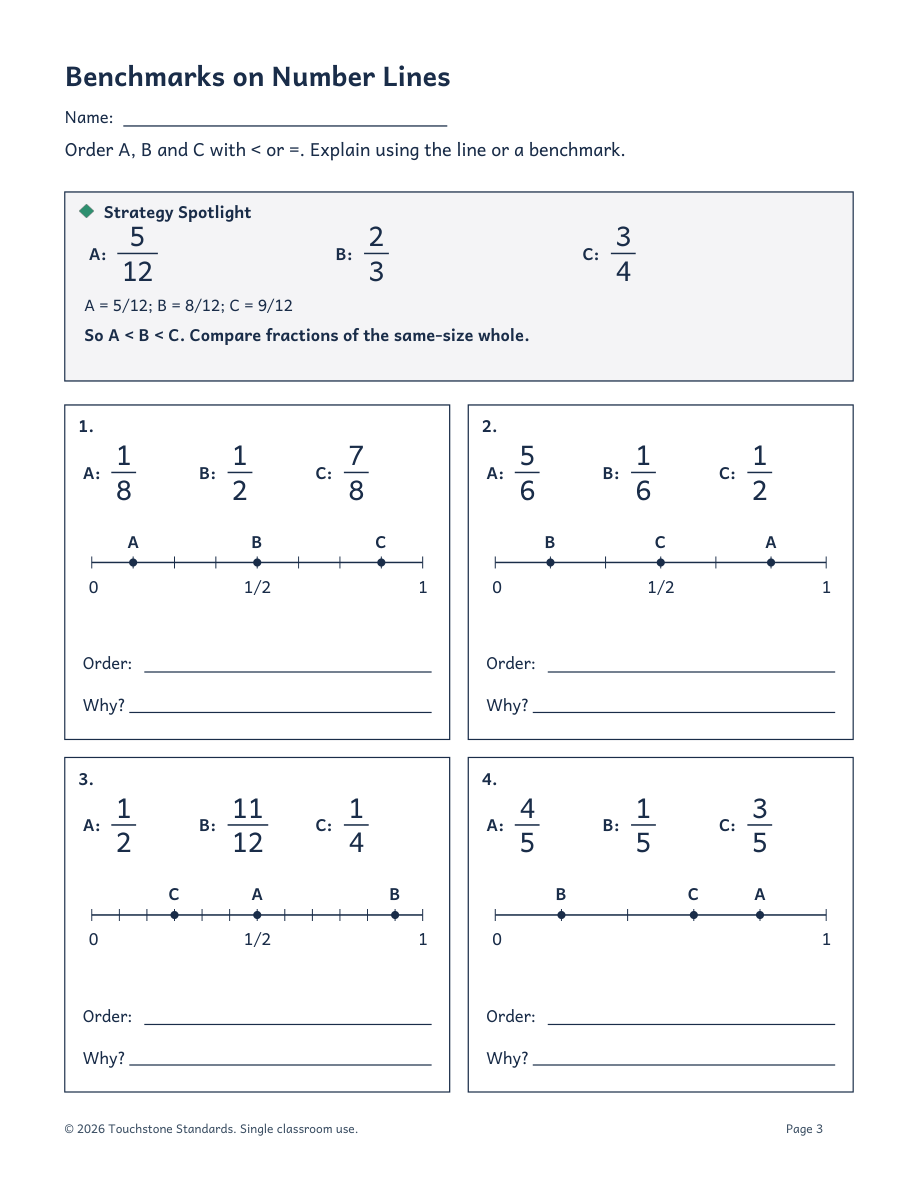
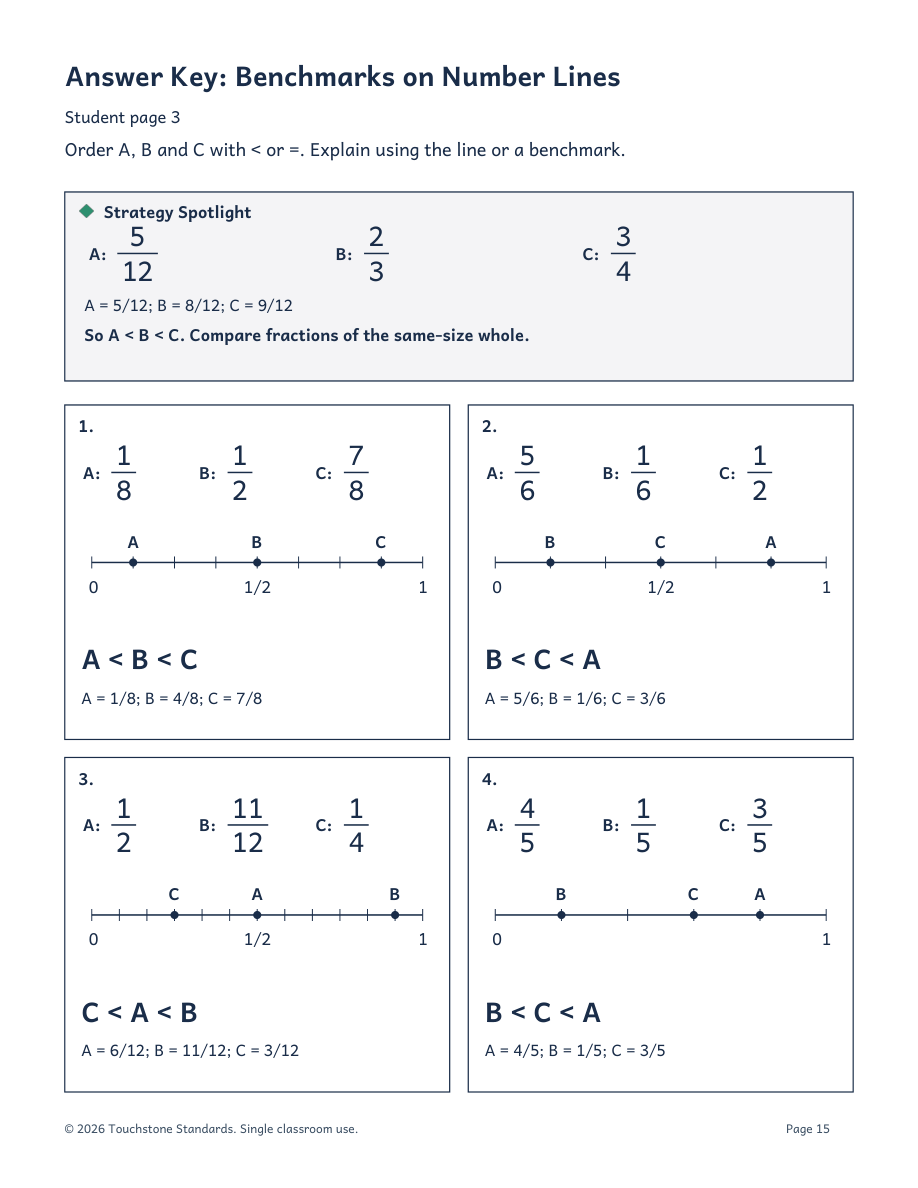
Benchmarks on Number Lines
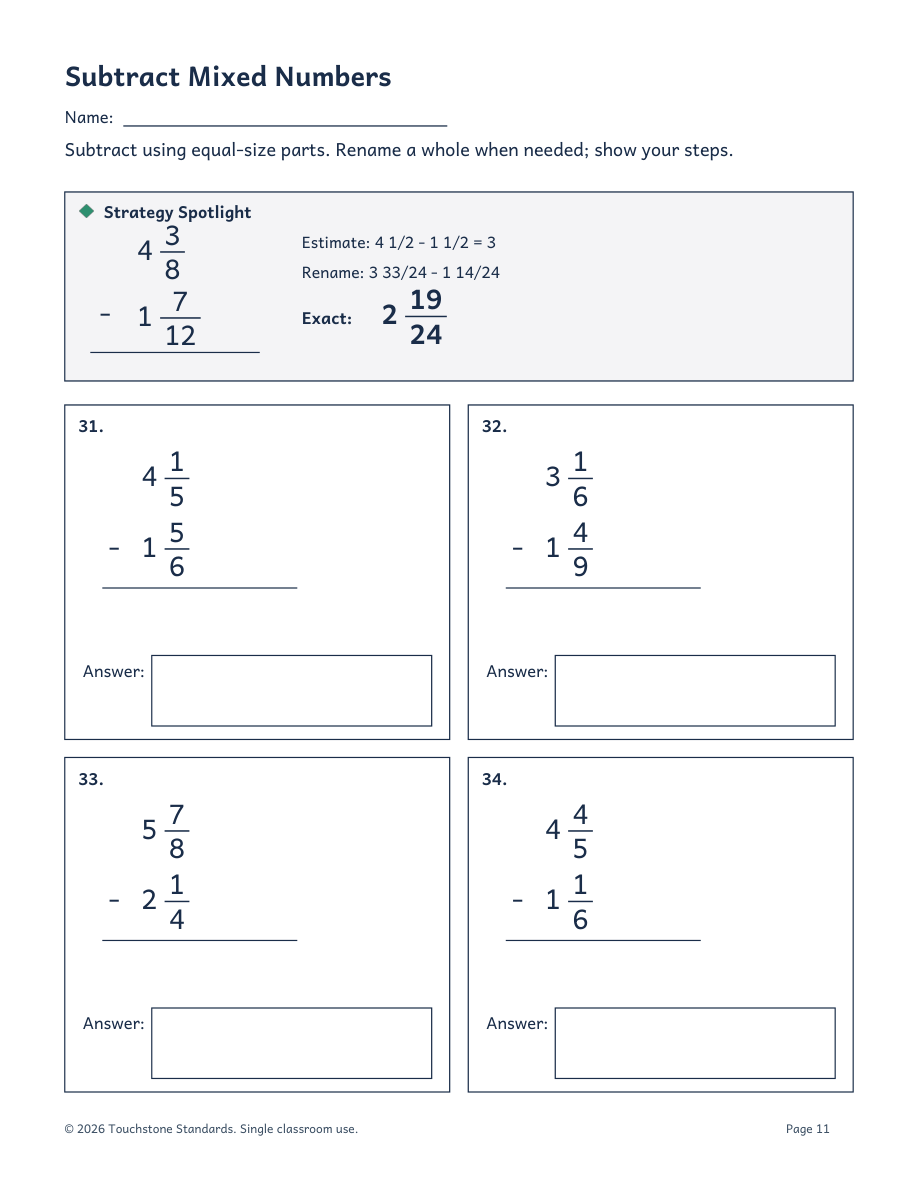
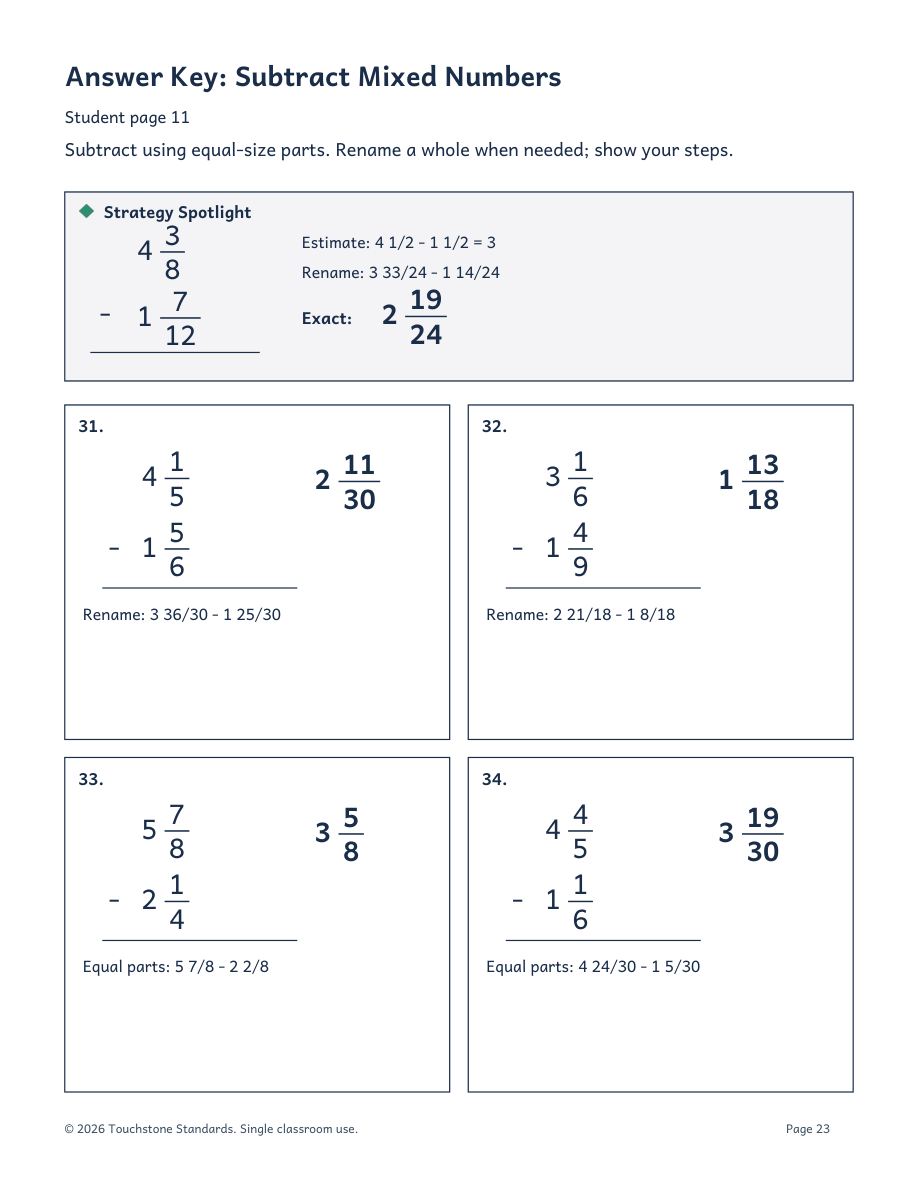
Subtract Mixed Numbers
What's inside
- p. 3
Benchmarks on Number Lines
- p. 4
Beyond One Whole
- p. 5
Compare with Common Parts
- p. 6
Fractions in Context
- p. 7
Rename, Then Combine
- p. 8
Add Unlike Fractions
- p. 9
Subtract Unlike Fractions
- p. 10
Add Mixed Numbers
- p. 11
Subtract Mixed Numbers
- p. 12
Estimate and Solve Stories
- p. 13
Fraction Code
- p. 14
Mixed Review
Georgia standards covered
5.NR.3.2
Compare and order up to three fractions with different numerators and/or different denominators by flexibly using a variety of tools and strategies.
In this packet: pages 3 to 6 and 14. 5.NR.3.2 practice in all our packets
5.NR.3.3
Model and solve problems involving addition and subtraction of fractions and mixed numbers with unlike denominators.
In this packet: pages 7 to 14. 5.NR.3.3 practice in all our packets
Who it's for
Students rename fractions, estimate before calculating and explain whether an answer makes sense. Subtracting mixed numbers includes examples with and without renaming a whole. The keys show sample models and worked steps, so you can see the reasoning behind each result. Comparisons refer to equal-size wholes. Denominators are 2, 3, 4, 5, 6, 8, 9, 10 and 12. Equivalent fractions and correct mixed or improper answers are accepted; simplifying is not required.