
What students practice
Distinguish times as many from an extra amount using tape diagrams and scaffolded letter frames. Rotate the unknown across diagram tasks, then multiply by tens, hundreds and thousands and use arrays, place splits and partial products for larger factors.
Inspect actual pages and matching keys
These complete pages come from this packet. Check the task, work space, and key before choosing.
Download the free 6-page PDF preview (cover, teacher page, and two complete practice/key pairs).
How Many Times?
Two-Digit by Two-Digit
What's inside
- p. 3
Times As Many
Use the diagrams. Find n and show your thinking.
- p. 4
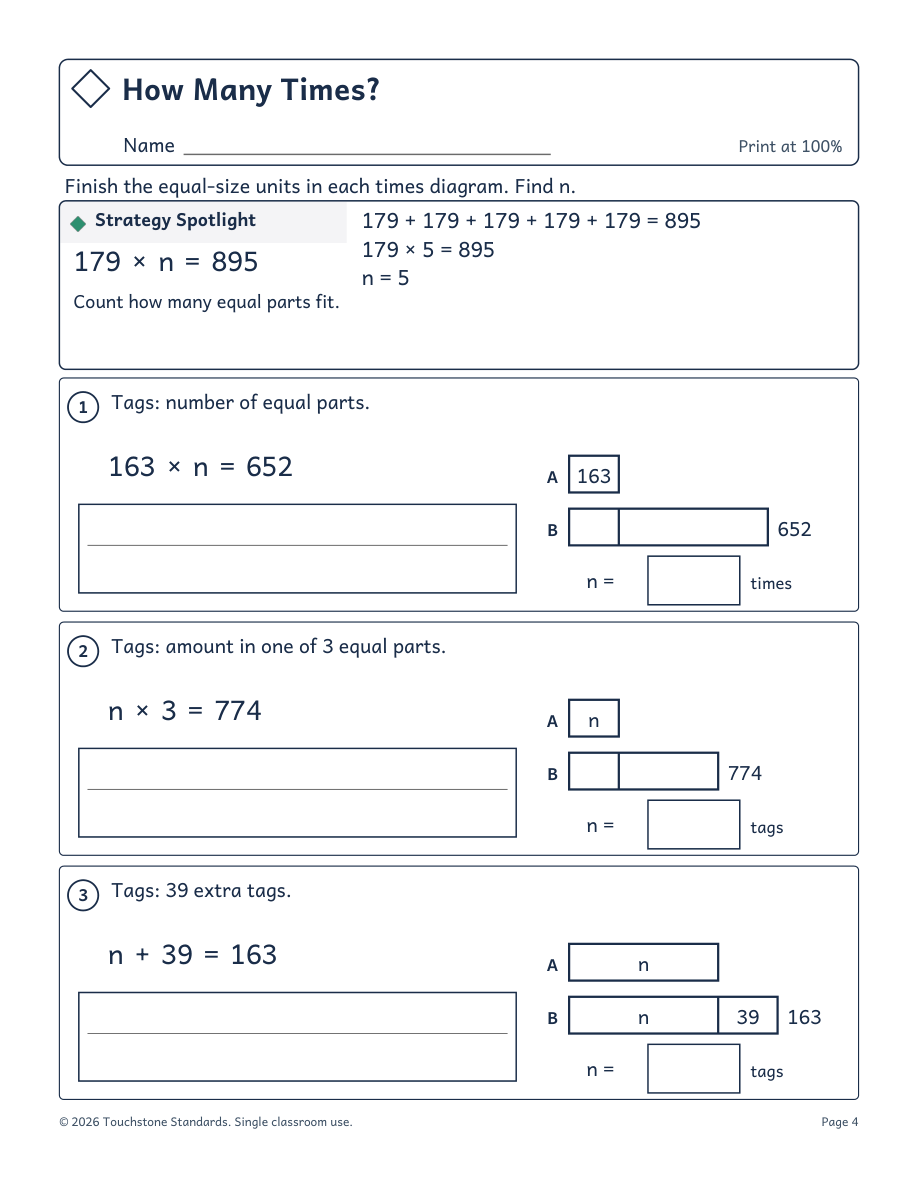
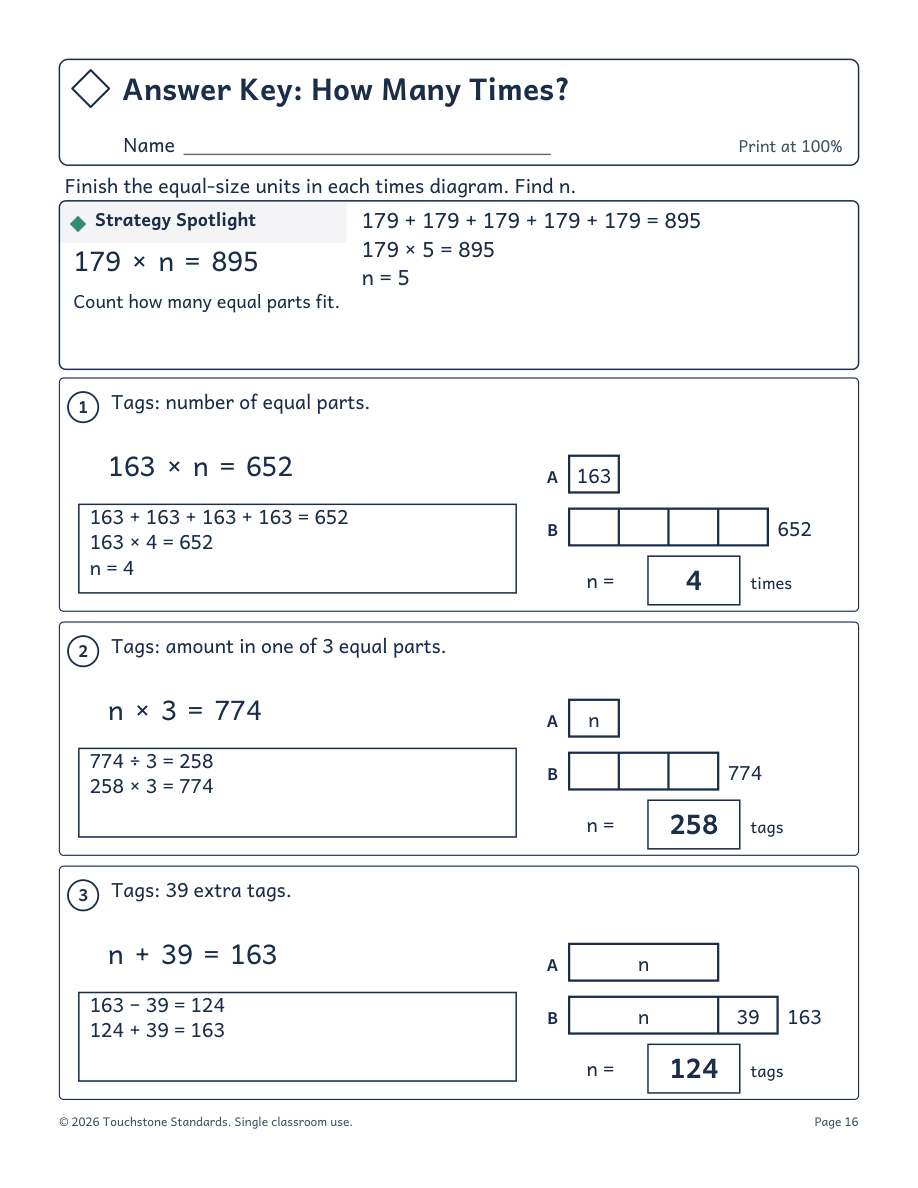
How Many Times?
Finish the equal-size units in each times diagram. Find n.
- p. 5
Times As Many or More Than?
Solve both. For item 1, select all statements the diagram shows.
- p. 6
Comparison Stories
Write a number sentence with n. Show your thinking.
- p. 7
Tens, Hundreds, Thousands
Use a known fact or model. Explain how place value gives the product.
- p. 8
Area Models: 2-Digit by 1-Digit
Fill the parts. Show the partial products and sum.
- p. 9
Area Models: Larger Factors
Fill each part. Write the partial products and their sum.
- p. 10
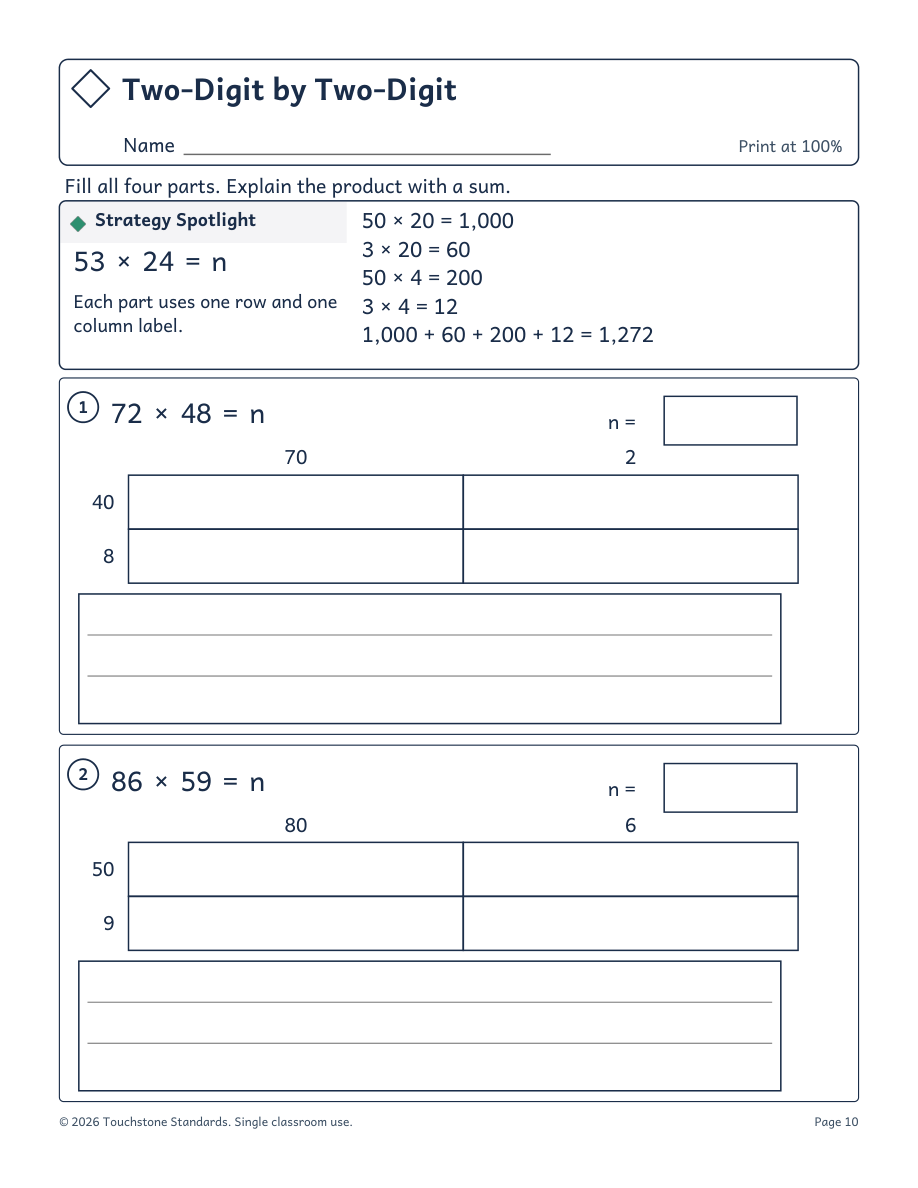
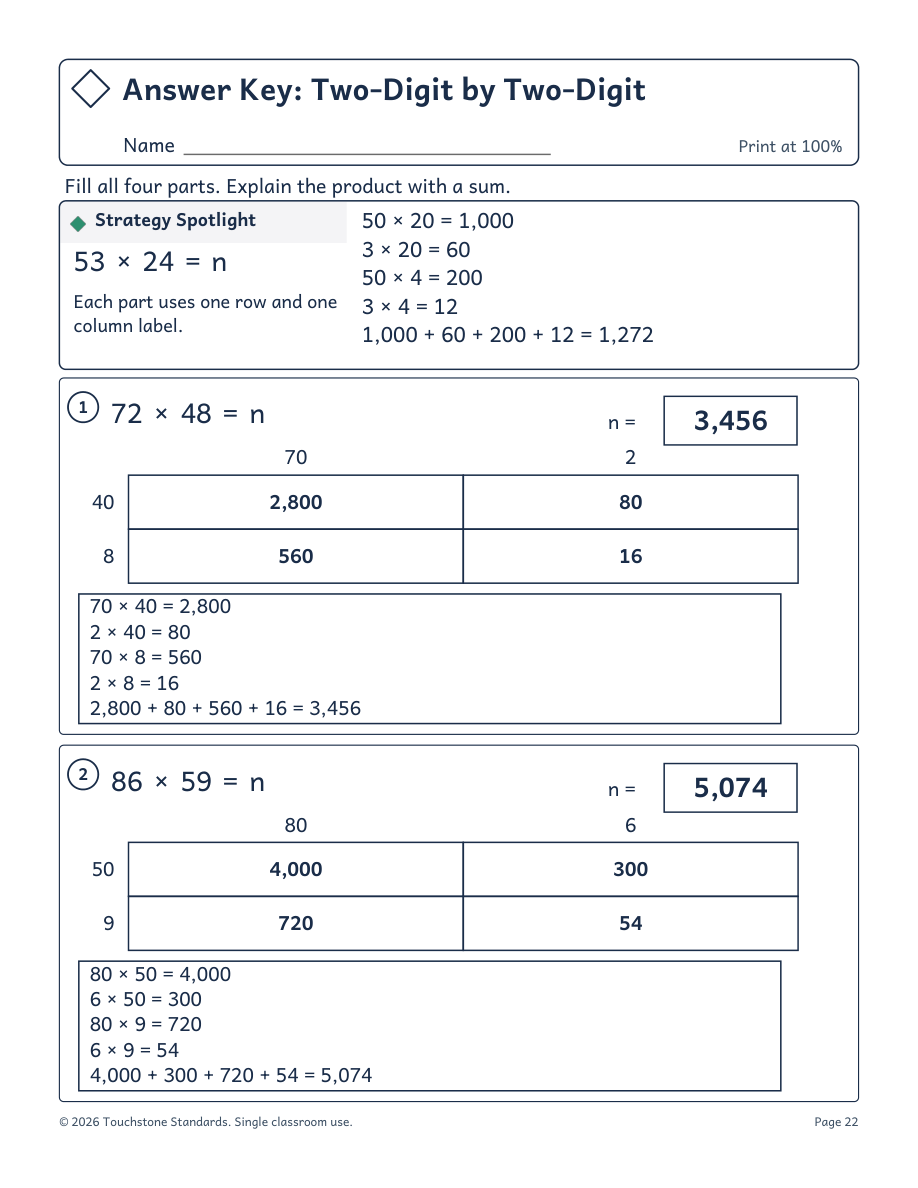
Two-Digit by Two-Digit
Fill all four parts. Explain the product with a sum.
- p. 11
Which Model Matches?
Choose the matching parts. Fill the next model and explain.
- p. 12
Multiplication Stories
Write a number sentence with n. Show an area model and partial products.
- p. 13
Product Code
Solve, match each answer to the table, then read the letters in order.
- p. 14
Mixed Review
Find n. Show the parts or diagram that support each answer.
Georgia standards covered
4.NR.2.2
Interpret, model, and solve problems involving multiplicative comparison.
In this packet: pages 3 to 6, 13, and 14. 4.NR.2.2 practice in all our packets
4.NR.2.3
Solve relevant problems involving multiplication of a number with up to four digits by a 1-digit whole number or involving multiplication of two two-digit numbers using strategies based on place value and the properties of operations. Illustrate and explain the calculation by using equations, rectangular arrays, and/or area models.
In this packet: pages 7 to 14. 4.NR.2.3 practice in all our packets
Who it's for
Grade 4 multiplicative comparison and multiplication lessons. Factors are up to four digits by one digit or two digits by two digits. The 26-page packet includes 28 numbered tasks, four full stories, 12 practice pages and 12 worked keys. Labeled area models are schematic.
More Grade 4 packets
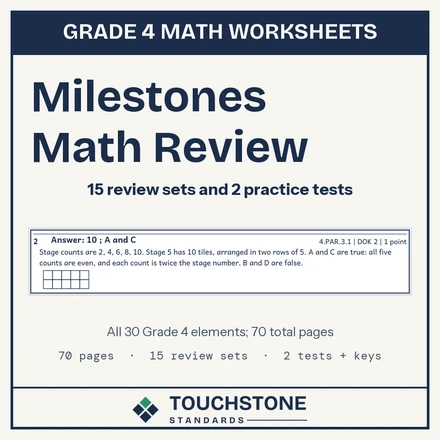 Milestones Math Review: 15 Review Sets and 2 Practice Tests4.NR.1.1 · 4.NR.1.2 · 4.NR.1.3 · 4.NR.1.4 · 4.NR.2.1 · 4.NR.2.2 · 4.NR.2.3 · 4.NR.2.4 · 4.NR.2.5 · 4.PAR.3.1 · 4.PAR.3.2 · 4.PAR.3.3 · 4.PAR.3.4 · 4.NR.4.1 · 4.NR.4.2 · 4.NR.4.3 · 4.NR.4.4 · 4.NR.4.5 · 4.NR.4.6 · 4.NR.5.1 · 4.NR.5.2 · 4.NR.5.3 · 4.MDR.6.1 · 4.MDR.6.2 · 4.MDR.6.3 · 4.GSR.7.1 · 4.GSR.7.2 · 4.GSR.8.1 · 4.GSR.8.2 · 4.GSR.8.3
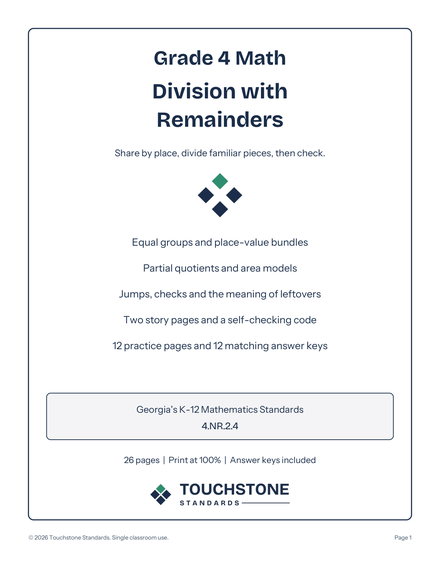 Division with Remainders4.NR.2.4
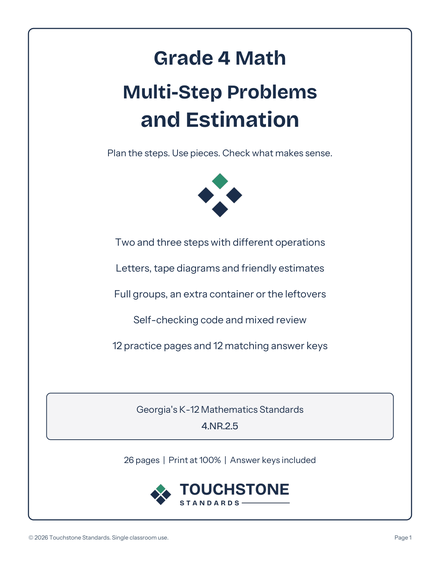 Multi-Step Problems and Estimation4.NR.2.5