
What students practice
Share equal groups, regroup labeled bundles, divide familiar pieces and put the partial quotients together. Complete missing sides in area models, use subtraction jumps, check claims and decide whether a story needs full groups, an extra container or the leftovers.
Inspect actual pages and matching keys
These complete pages come from this packet. Check the task, work space, and key before choosing.
Download the free 6-page PDF preview (cover, teacher page, and two complete practice/key pairs).
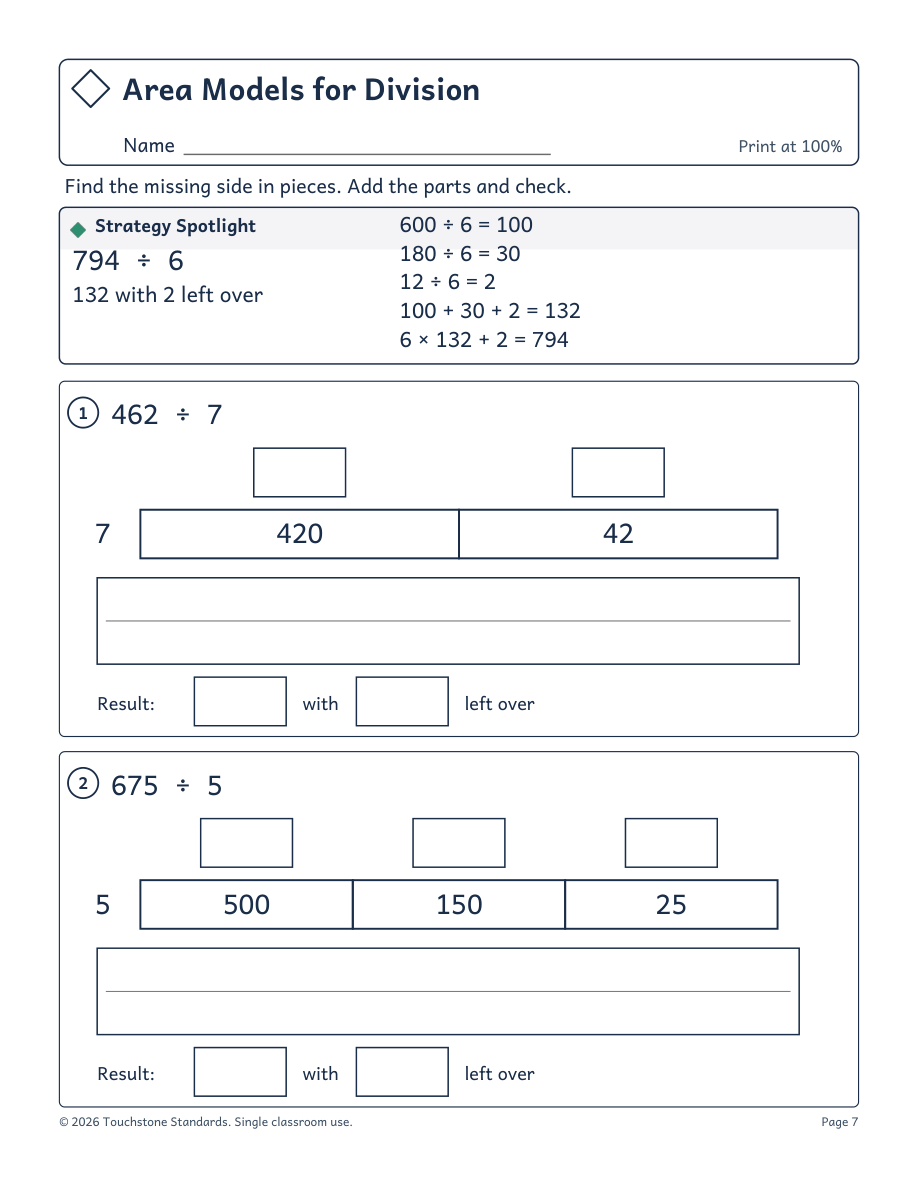
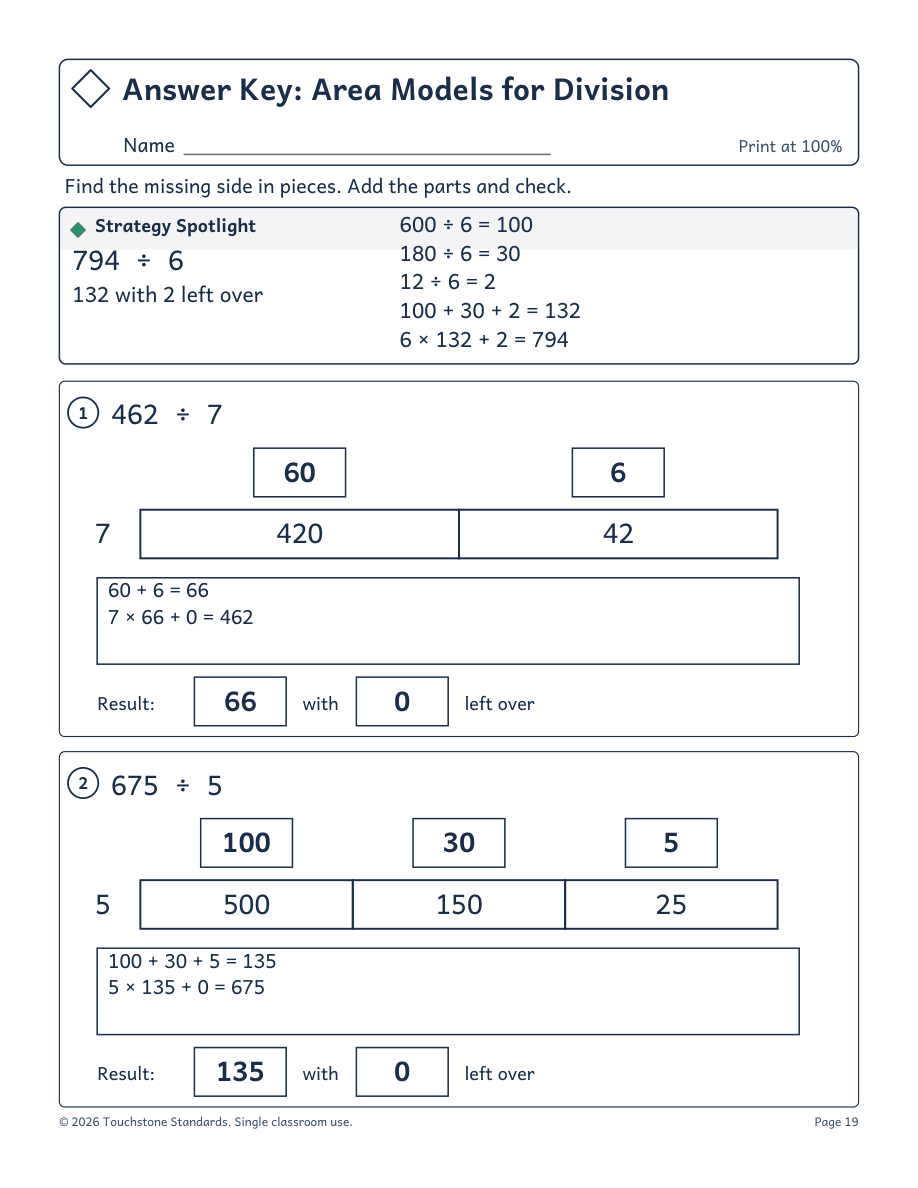
Area Models for Division
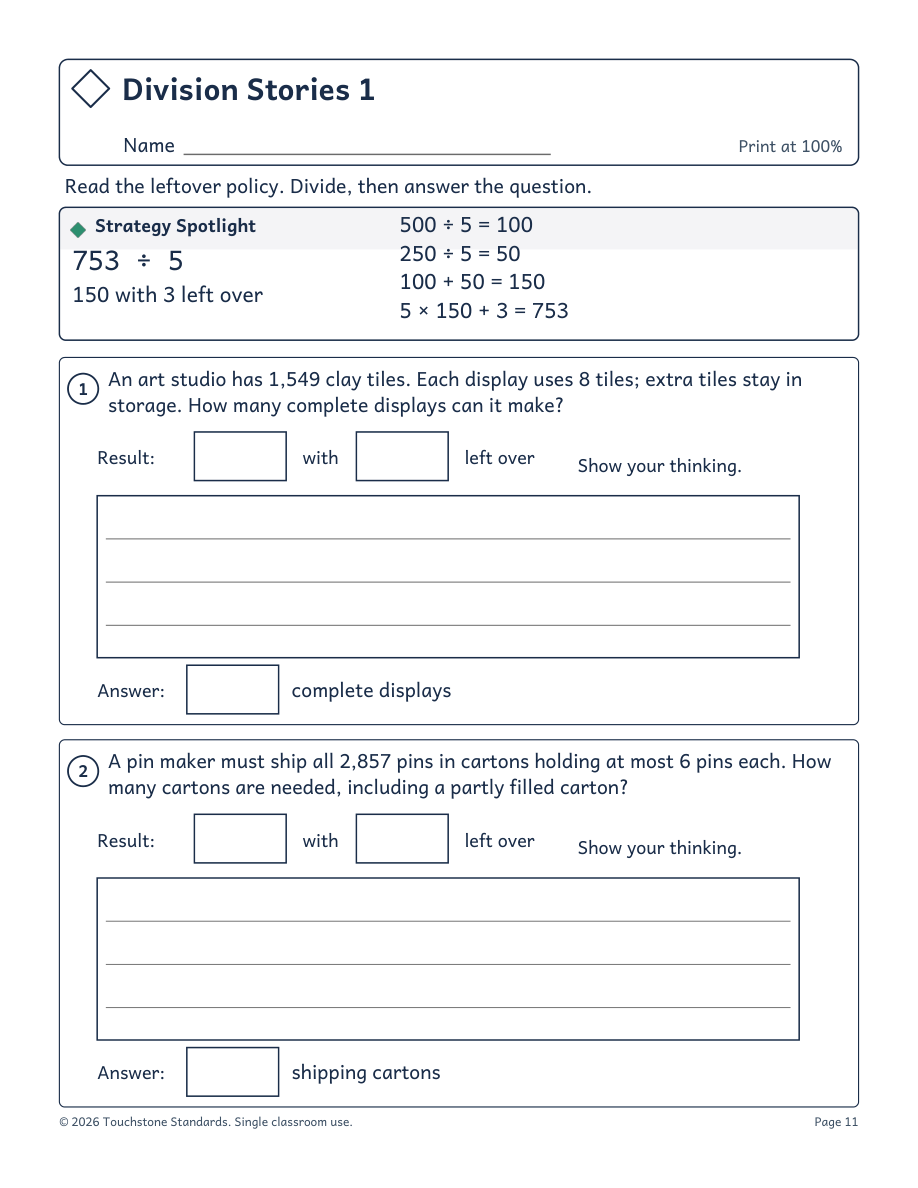
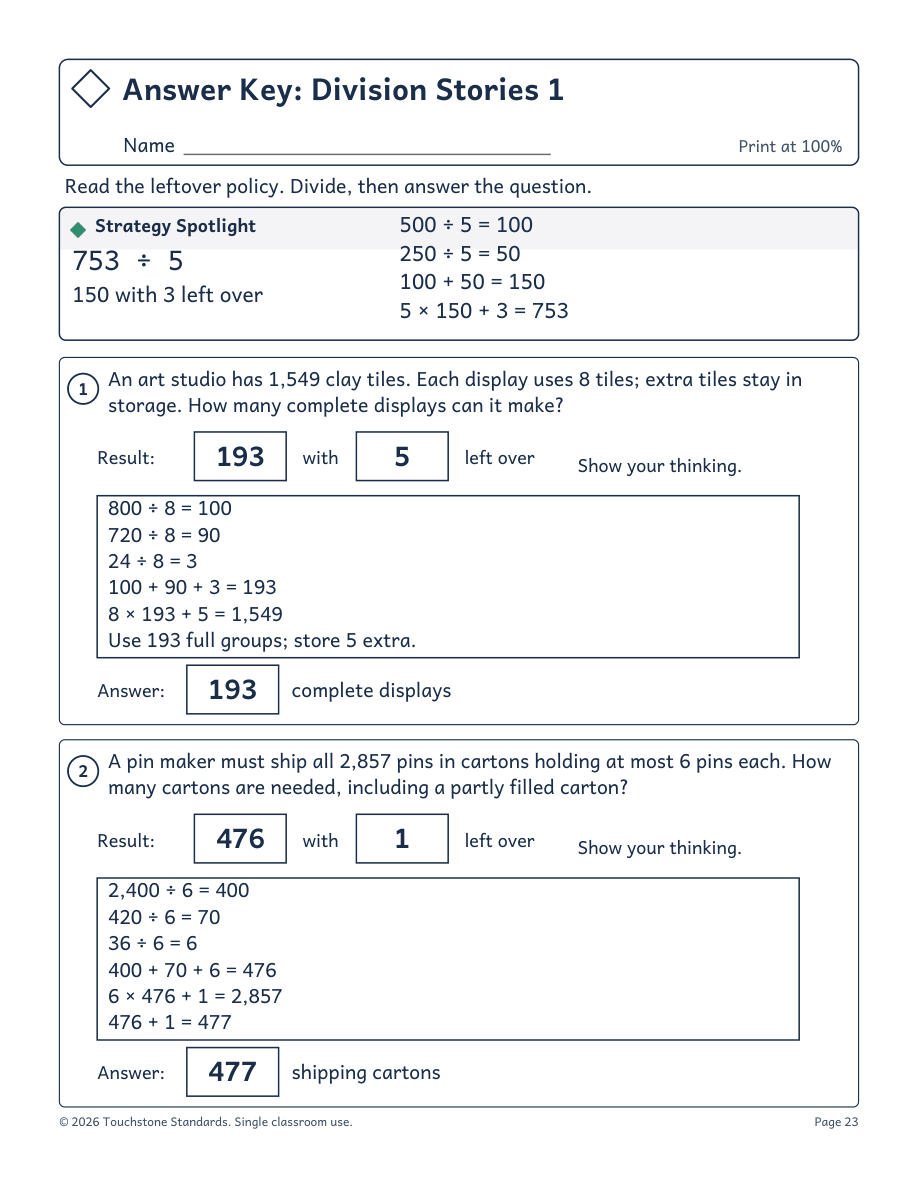
Division Stories 1
What's inside
- p. 3
Share It Out
Count the groups or use the bundles to share. Show your thinking.
- p. 4
Divide by Place
Divide each place-value piece, then put the parts together.
- p. 5
Partial Quotients
Split into familiar pieces, divide each piece, then add.
- p. 6
Remainders
Find the quotient and amount left over. Check by multiplying.
- p. 7
Area Models for Division
Find the missing side in pieces. Add the parts and check.
- p. 8
Four-Digit Dividends
Divide by place or use familiar pieces. Check your result.
- p. 9
Jumps and Repeated Subtraction
Use jumps and subtraction, or show another correct strategy.
- p. 10
Check It
Check each claim. Correct the result and show why.
- p. 11
Division Stories 1
Read the leftover policy. Divide, then answer the question.
- p. 12
Division Stories 2
Read the leftover policy. Divide, then answer the question.
- p. 13
Quotient Code
Divide, then use each quotient to find a letter in the table.
- p. 14
Mixed Review
Show your thinking and follow the directions for each item.
Georgia standards covered
4.NR.2.4
Solve authentic division problems involving up to 4-digit dividends and 1-digit divisors (including whole number quotients with remainders) using strategies based on place-value understanding, properties of operations, and the relationships between operations.
In this packet: pages 3 to 14. 4.NR.2.4 practice in all our packets
Who it's for
Grade 4 division with 2- to 4-digit dividends and one-digit divisors 2 to 9. Four-digit practice begins on page 8. The 26-page packet includes 25 tasks, four original stories, 12 practice pages and 12 matching worked keys. Separate boxes record quotient and leftovers; R notation is also accepted.
More Grade 4 packets
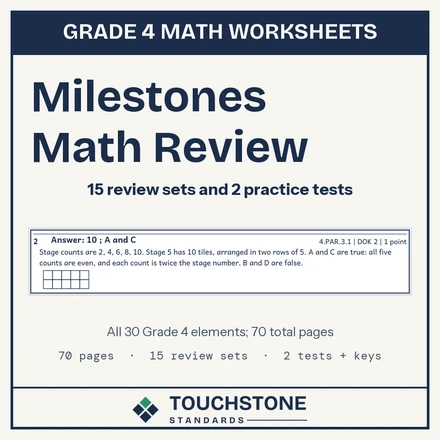 Milestones Math Review: 15 Review Sets and 2 Practice Tests4.NR.1.1 · 4.NR.1.2 · 4.NR.1.3 · 4.NR.1.4 · 4.NR.2.1 · 4.NR.2.2 · 4.NR.2.3 · 4.NR.2.4 · 4.NR.2.5 · 4.PAR.3.1 · 4.PAR.3.2 · 4.PAR.3.3 · 4.PAR.3.4 · 4.NR.4.1 · 4.NR.4.2 · 4.NR.4.3 · 4.NR.4.4 · 4.NR.4.5 · 4.NR.4.6 · 4.NR.5.1 · 4.NR.5.2 · 4.NR.5.3 · 4.MDR.6.1 · 4.MDR.6.2 · 4.MDR.6.3 · 4.GSR.7.1 · 4.GSR.7.2 · 4.GSR.8.1 · 4.GSR.8.2 · 4.GSR.8.3
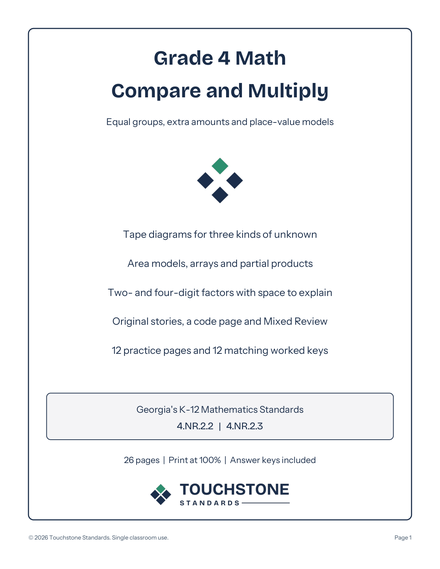 Multiplicative Comparison and Multiplying4.NR.2.2 · 4.NR.2.3
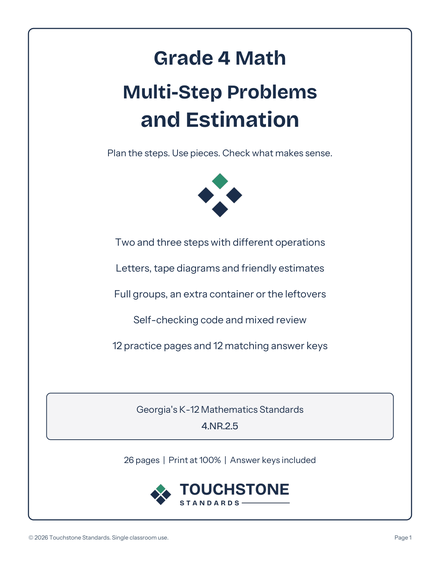 Multi-Step Problems and Estimation4.NR.2.5