What students practice
Start with two rays and their shared endpoint, classify angles against a known right angle, and draw on dot grids. Then share a circle into equal wedges, count wedges and unit angles, estimate and read printed 360-degree protractors, and use a classroom protractor. Angle stories, Angle Code, and Mixed Review complete the sequence.
Inspect actual pages and matching keys
These complete pages come from this packet. Check the task, work space, and key before choosing.
Download the free 6-page PDF preview (cover, teacher page, and two complete practice/key pairs).
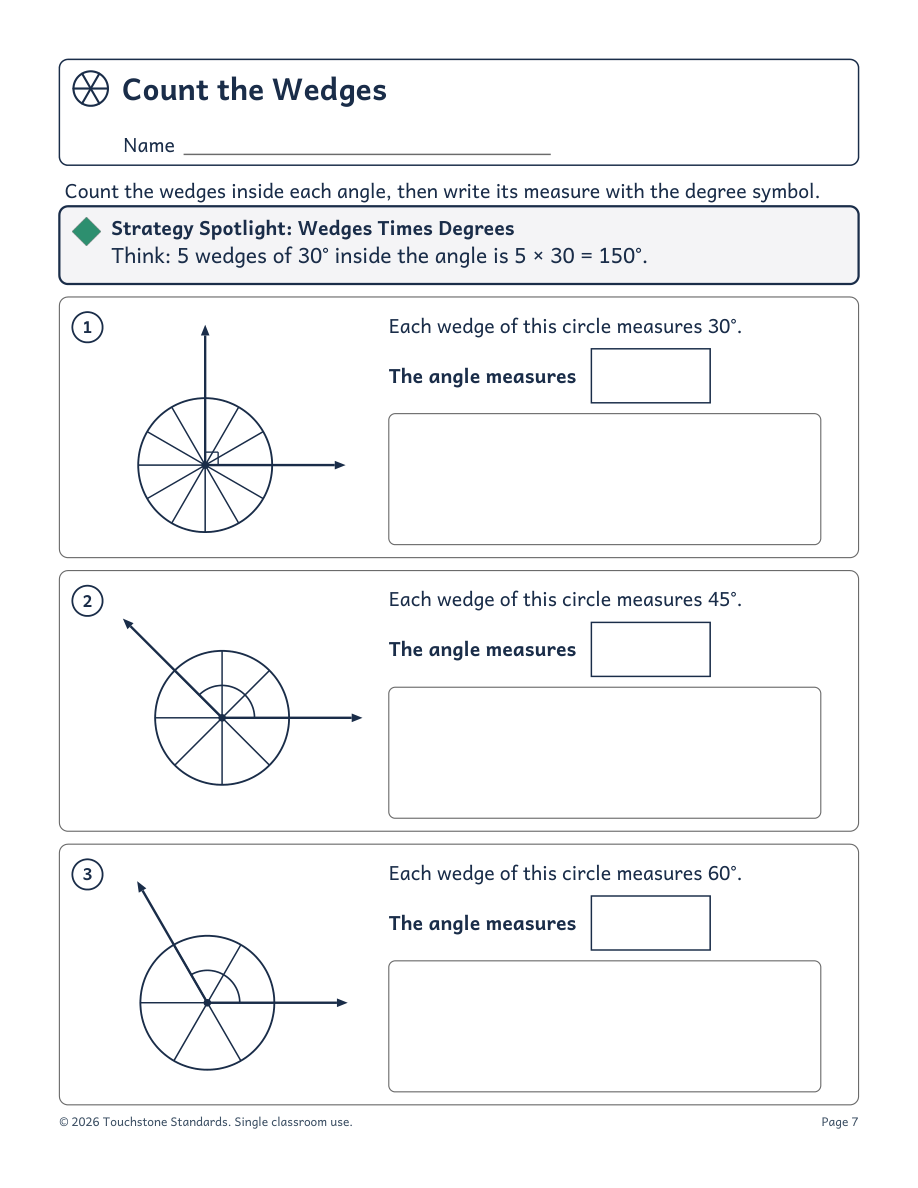
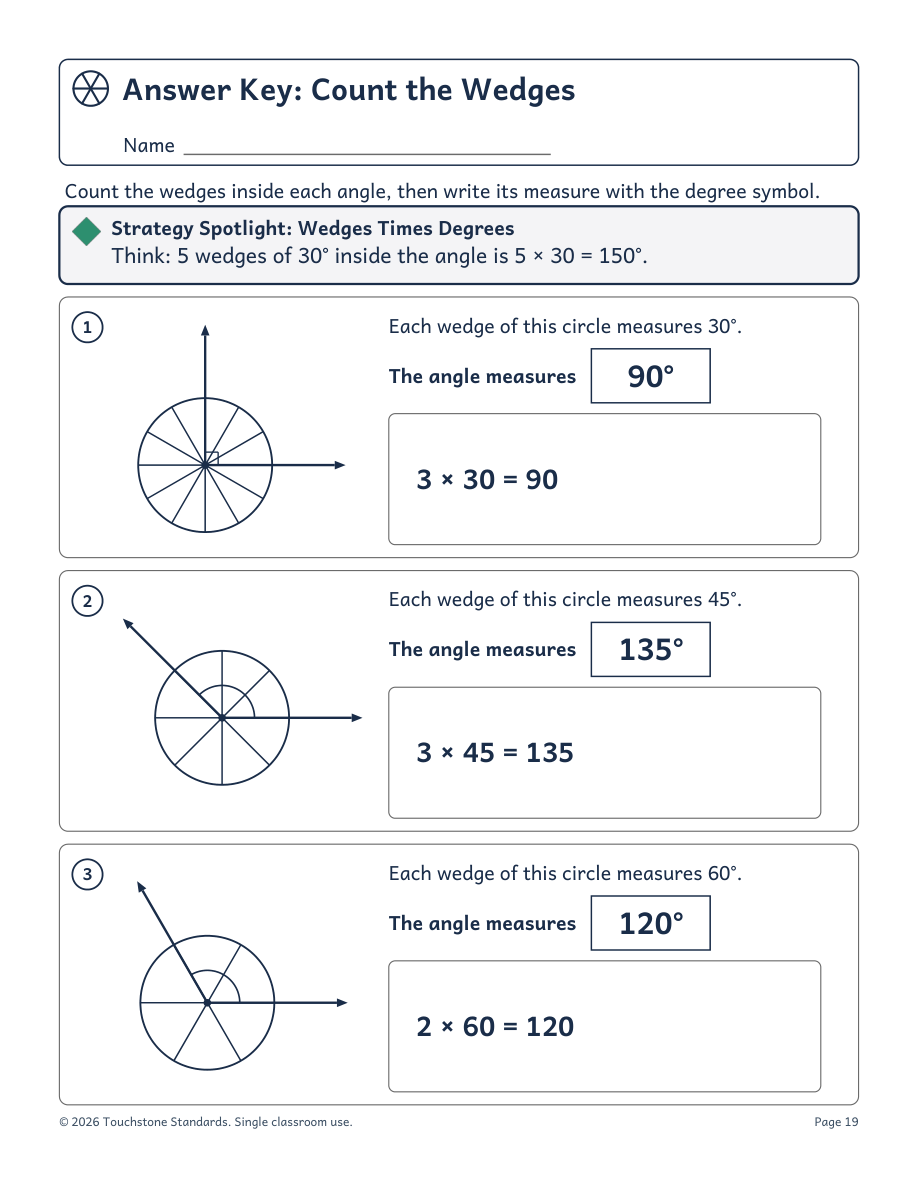
Count the Wedges
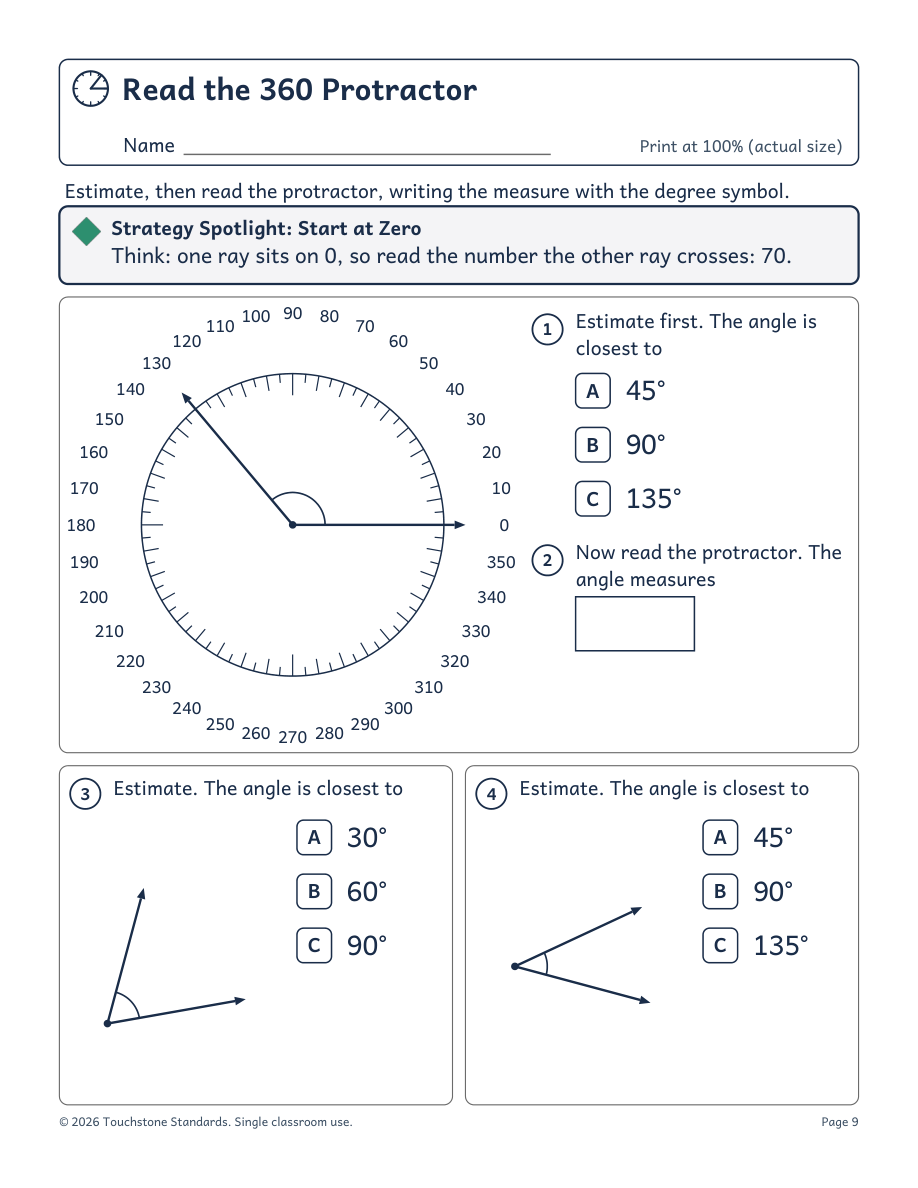
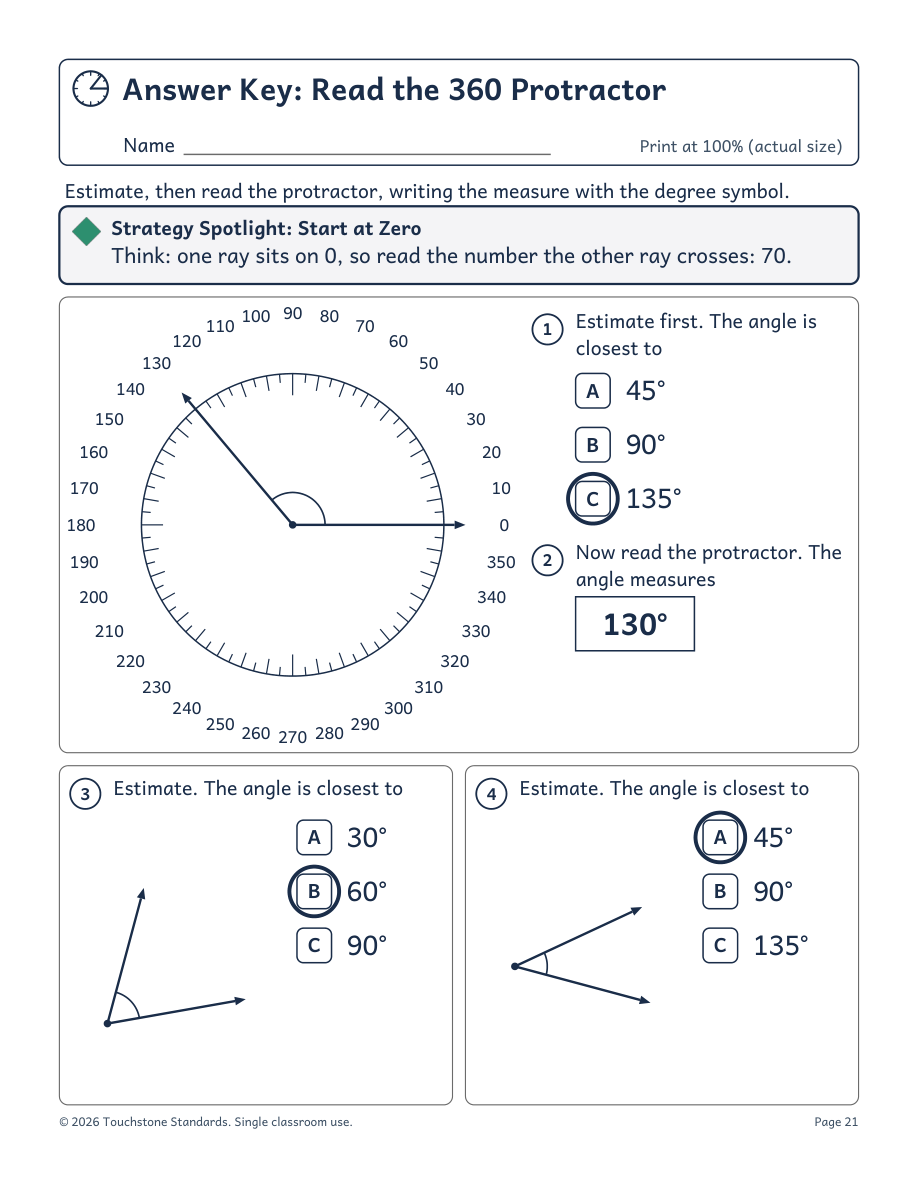
Read the 360 Protractor
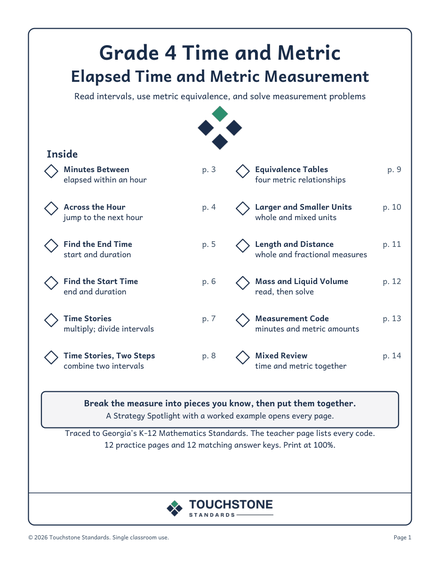
What's inside
- p. 3
Two Rays, One Endpoint
Decide which figures are angles, then find each vertex.
- p. 4
Right, Acute, or Obtuse
Compare each angle with the known right angle, then circle its name.
- p. 5
Draw Angles
Draw a second ray from the dot to make each angle, then answer the questions.
- p. 6
Wedges of a Circle
Find the measure of one wedge by completing each number sentence.
- p. 7
Count the Wedges
Count the wedges inside each angle, then write its measure with the degree symbol.
- p. 8
Unit Angles
Count the unit angles that fit, then write the measure with the degree symbol.
- p. 9
Read the 360 Protractor
Estimate, then read the protractor, writing the measure with the degree symbol.
- p. 10
Measure on the Protractor
Read the protractor, check each reading, then write it with the degree symbol.
- p. 11
Use Your Own Protractor
Use your protractor, write each measure with the degree symbol, then circle its name.
- p. 12
Angle Stories
Read each story, show your thinking, then write the measure with the degree symbol.
- p. 13
Angle Code
Answer each question, writing measures with the degree symbol, then spell the word.
- p. 14
Mixed Review
Solve each problem, writing angle measures with the degree symbol.
Georgia standards covered
4.GSR.7.1
Recognize angles as geometric shapes formed when two rays share a common endpoint. Draw right, acute, and obtuse angles based on the relationship of the angle measure to 90 degrees.
In this packet: pages 3 to 5, 11, 13, and 14. 4.GSR.7.1 practice in all our packets
4.GSR.7.2
Measure angles in reference to a circle with the center at the common endpoint of two rays. Determine an angle’s measure in relation to the 360 degrees in a circle through division or as a missing factor problem.
In this packet: pages 6 to 14. 4.GSR.7.2 practice in all our packets
Who it's for
Grade 4 lessons on classifying and measuring angles. Wedges and unit angles come before protractors. Angle measures use multiples of 5 from 10 to 170 degrees. Students write the degree symbol in measure boxes; the own-protractor key accepts 5 degrees either way. The 26-page packet includes 12 practice pages, 12 matching keys, a cover, and a teacher page.