What students practice
Help students look beyond a shape's appearance and use its attributes. Classify triangles and quadrilaterals, compare regular and irregular polygons, and explain why a shape can belong to more than one family. Also aligned with Common Core: 5.G.B.3 and 5.G.B.4 (classifying with provided family diagrams).
Inspect actual pages and matching keys
These complete pages come from this packet. Check the task, work space, and key before choosing.
Download the free 6-page PDF preview (cover, teacher page, and two complete practice/key pairs).
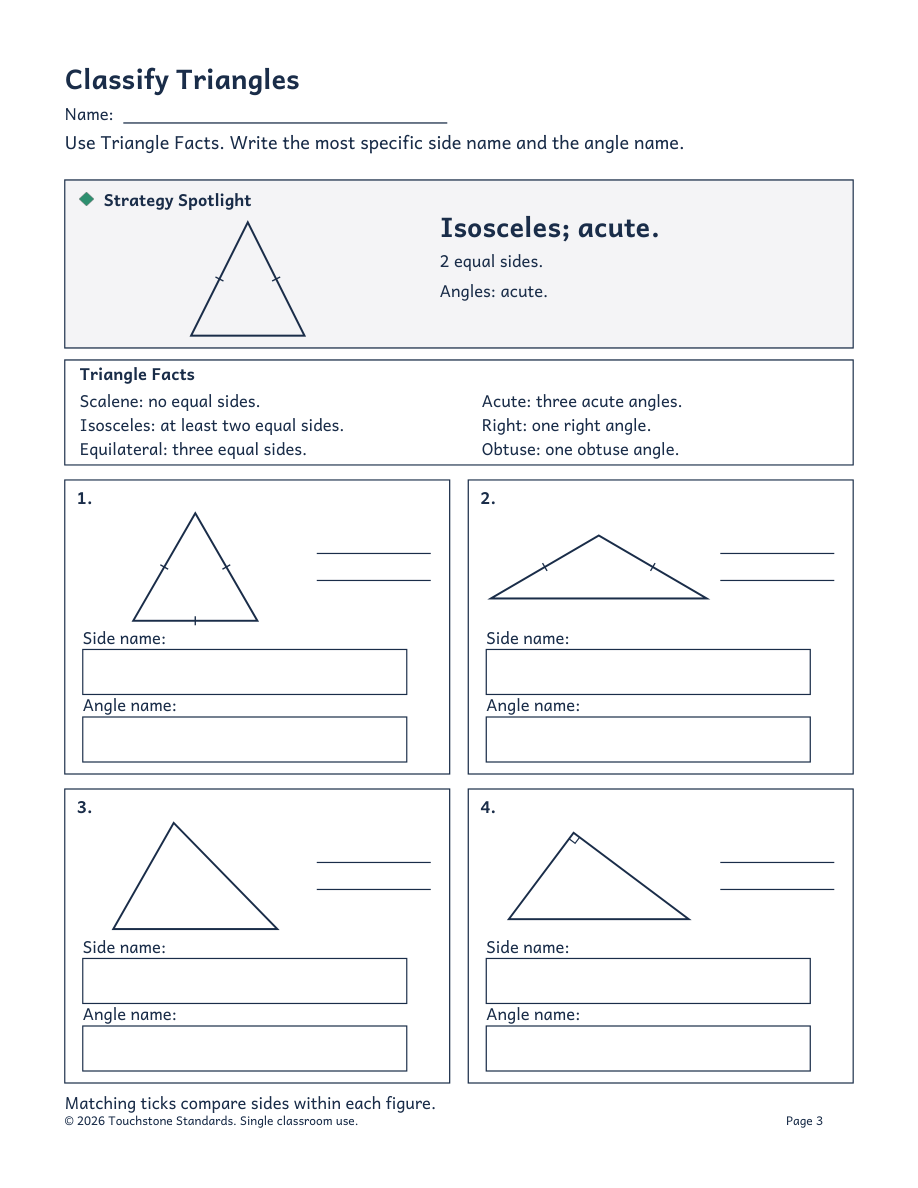
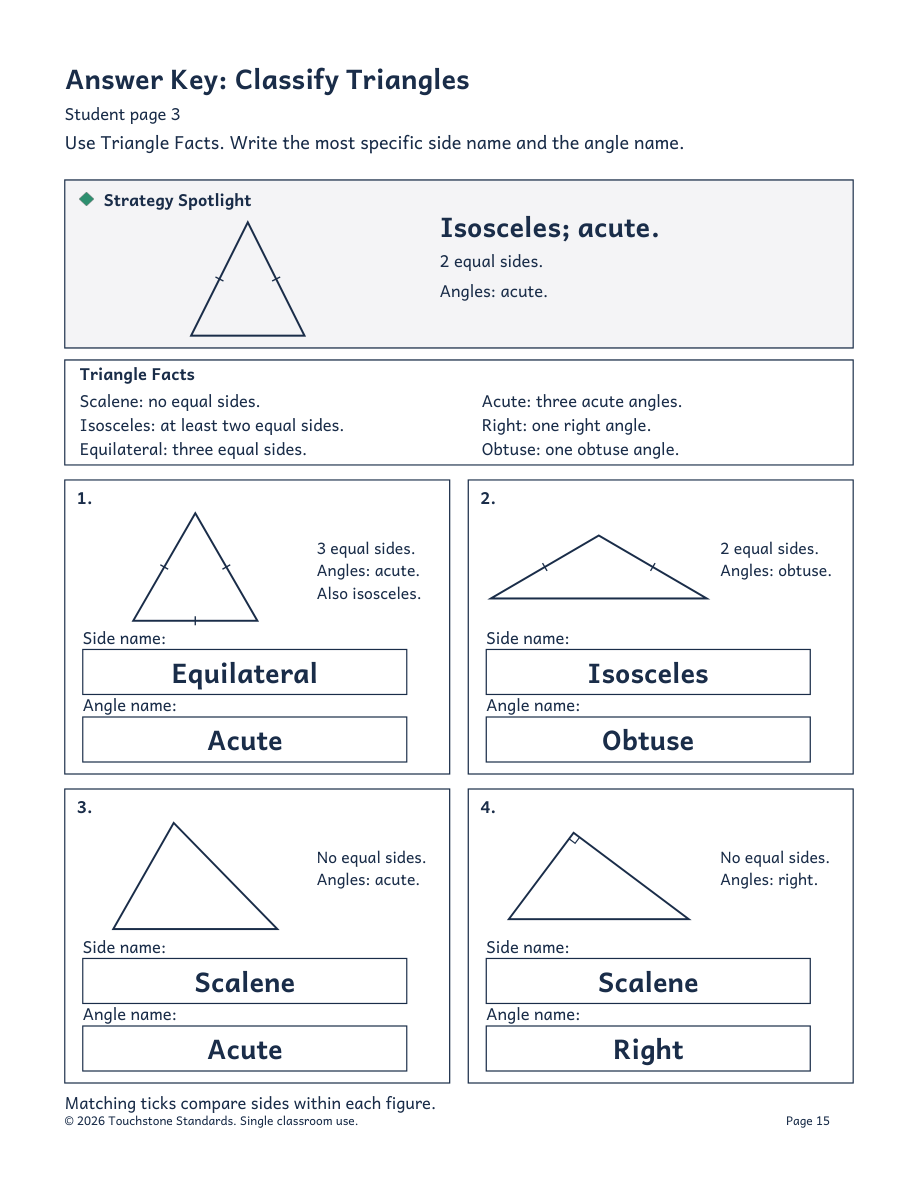
Classify Triangles
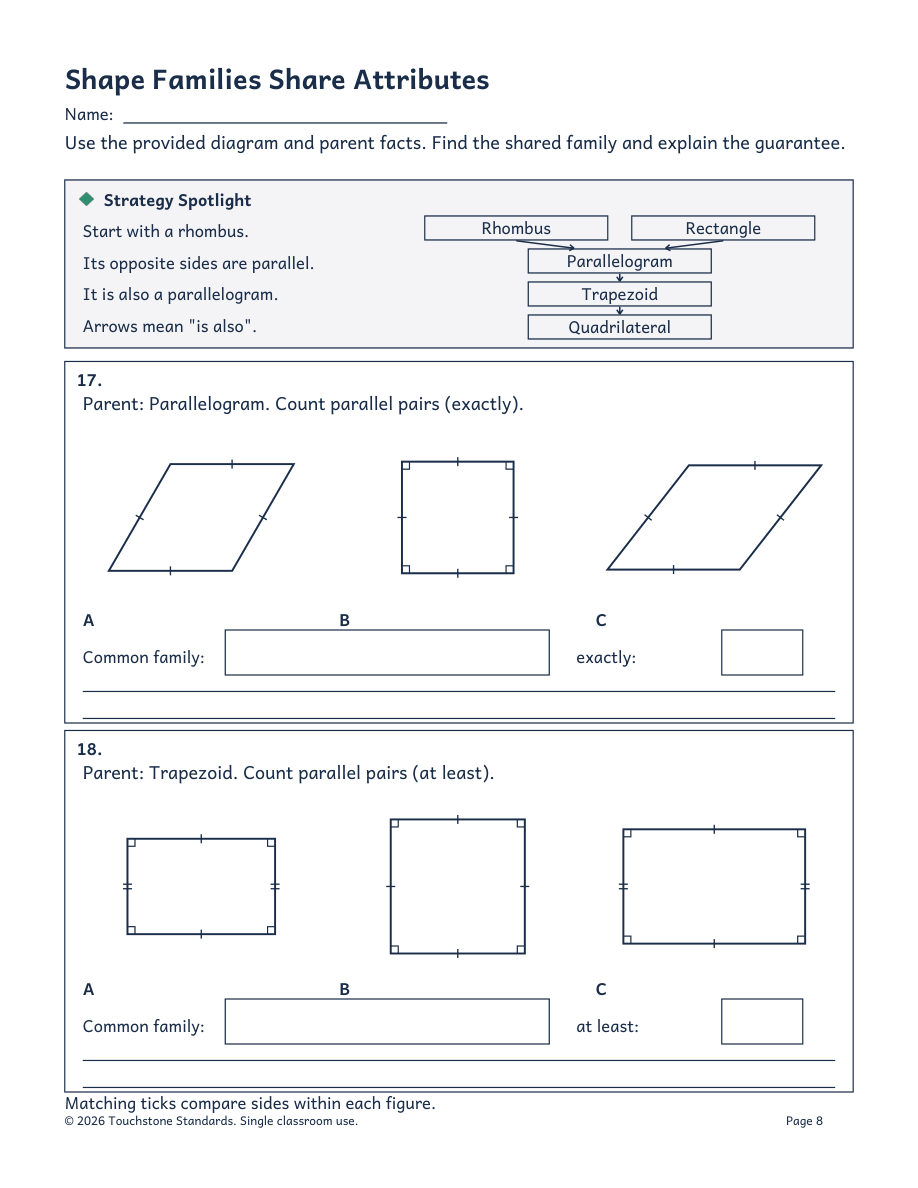
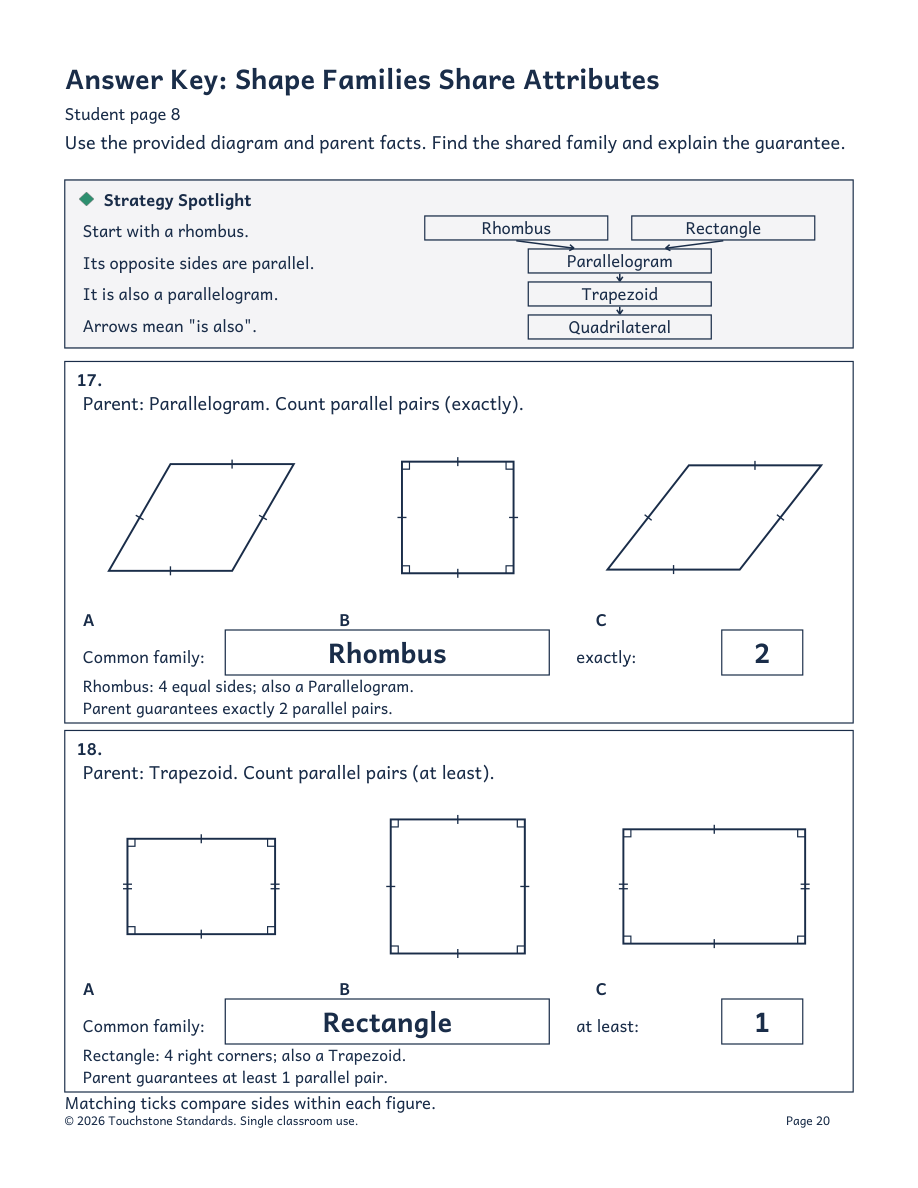
Shape Families Share Attributes
What's inside
- p. 3
Classify Triangles
- p. 4
Quadrilateral Attributes
- p. 5
More Than One Family
- p. 6
Regular and Irregular Polygons
- p. 7
Compare Two Polygons
- p. 8
Shape Families Share Attributes
- p. 9
From a Family to Its Members
- p. 10
Test a Family Claim
- p. 11
Symmetry and Same Size
- p. 12
Sort the Craft Cutouts
- p. 13
Shape Code
- p. 14
Mixed Review
Georgia standards covered
5.GSR.8.1
Classify, compare, and contrast polygons based on properties.
In this packet: pages 3 to 14. 5.GSR.8.1 practice in all our packets
5.GSR.8.2
Determine, through exploration and investigation, that attributes belonging to a category of two-dimensional figures also belong to all subcategories of that category.
In this packet: pages 8 to 10, 12, and 14. 5.GSR.8.2 practice in all our packets
Who it's for
The 32 multi-part items use visible side and angle marks, supplied family diagrams, symmetry lines and congruent pairs. Students select every family name that fits, follow inherited attributes, test false claims and sort shapes in one full-width story. Worked keys explain the defining attributes. The classification is inclusive: a square can also be a rectangle and a rhombus. Students use provided family diagrams; they do not build a hierarchy from scratch. Regularity, symmetry and congruence questions use the printed figures and marks.