What students practice
Students match nets to solids, count faces, and find the surface area of rectangular prisms, cubes, triangular prisms, and pyramids. Every surface-area item prints the net. Volume pages pack cubes with edges of one half or one third, multiply the area of the base by the height, and find one missing edge. Every volume item has a fractional edge, and those denominators are 2, 3, and 5. Net edges are whole numbers.
What's inside
- p. 3
Nets and Solids
Write the letter of the solid each net folds into, and count its faces.
- p. 4
Box Nets on a Grid
Count the squares in each lettered face, then find the total.
- p. 5
Box Nets With Labels
Use the labels to find the area of each lettered face, then the total.
- p. 6
Triangular Prism Nets
Find the area of each lettered face, then add to find the total.
- p. 7
Pyramid Nets
Find the area of the base and of each triangle, then the total.
- p. 8
Surface Area in the Real World
Use the net and the story to solve each problem.
- p. 9
Surface Area Code
Find each surface area, then write its letter from the code bank.
- p. 10
Pack It With Cubes
Count the small cubes, then find the volume of each box.
- p. 11
Base Times Height
Find the area of the base, then multiply by the height.
- p. 12
Length, Width, and Height
Find each volume or missing edge.
- p. 13
Volume in the Real World
Use the picture and the story to solve each problem.
- p. 14
Mixed Review
Solve each problem, then check your work.
Think: each shape in a net is 1 face of the solid, so count the shapes.
Georgia standards covered
6.GSR.5.2
Given the net of three-dimensional figures with rectangular and triangular faces, determine the surface area of these figures.
In this packet: pages 3 to 9 and 14. 6.GSR.5.2 practice in all our packets
6.GSR.5.3
Calculate the volume of right rectangular prisms with fractional edge lengths by applying the formula, V = (area of base) x (height).
In this packet: pages 10 to 14. 6.GSR.5.3 practice in all our packets
Who it's for
Grade 6 classes on the second half of the area and volume unit, after area of polygons. Faces are rectangles and triangles only. There is no cylinder, no circle, and no volume displacement.
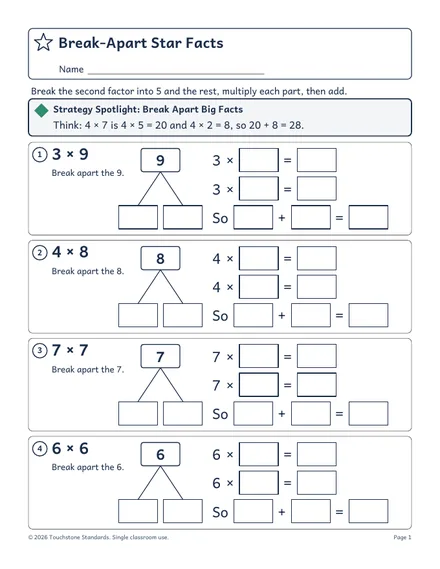 See the format first, free. Our free Grade 3 sample, Break-Apart Star Facts, shows the same page layout and answer key style.